
 By Dr Andrew Smith | Medical Director, Wilmer Health | Published: 25 April 2025 | Last Update: 26 April 2026
This guide is reviewed regularly to reflect current Spanish consulate requirements. Last updated in 2026 by Dr Andrew Smith, Medical Director, Wilmer Health. For specific advice about your individual application, contact us at hello@wilmerhealth.com.
If you’re moving to Spain with your family, whether on a Non-Lucrative Visa, Student Visa, Digital Nomad Visa, or through a Family Reunification Visa, you might be wondering whether your children need their own medical certificate.
Here’s what you need to know, for applicants in both the UK and the USA. For the full picture on the medical certificate process, read our complete guides for UK applicants and US applicants.
Yes. Every person in the application, regardless of age, needs their own separately issued medical certificate. There is no shared family certificate. Babies, toddlers, and teenagers all need their own.
If you’re applying as a family with two children, that’s four separate certificates: one for each parent and one for each child.
This surprises a lot of families, especially those with very young children. The rule is the same across all ages and all long-stay visa types.
No. It’s exactly the same document as the one an adult would need. Same wording, same format, same requirements. The only difference is that the child’s name goes on the certificate instead of an adult’s.
The wording follows the same format we cover in our guide on what your Spanish visa medical certificate should say, a declaration that the named person does not suffer from any disease with serious public health implications in accordance with the International Health Regulations (2005).
A few common questions worth addressing:
Is there a minimum age? No. Certificates can be issued for children of any age, including newborns. The certificate confirms the named person does not have any of the infectious diseases listed under the IHR 2005, which applies regardless of age.
Do chronic conditions matter? No. The IHR 2005 covers specific infectious diseases that pose a public health risk (tuberculosis, cholera, yellow fever, plague, smallpox, poliomyelitis, SARS, and others). Common chronic conditions like asthma, eczema, allergies, or ADHD do not affect the certificate.
Are vaccinations required? No, vaccinations are not required for the medical certificate. Some Spanish schools may have their own vaccination requirements, but that is separate from the visa medical certificate.

For younger children, a parent or guardian fills in the application on their behalf. You’ll provide your child’s name, date of birth, and basic health information. The certificate is then issued in the child’s name, signed by the doctor, and meets the same requirements as an adult certificate.
For older children and teenagers who can answer their own health questions, the application process is the same, but a parent or guardian still needs to consent to and submit the application.
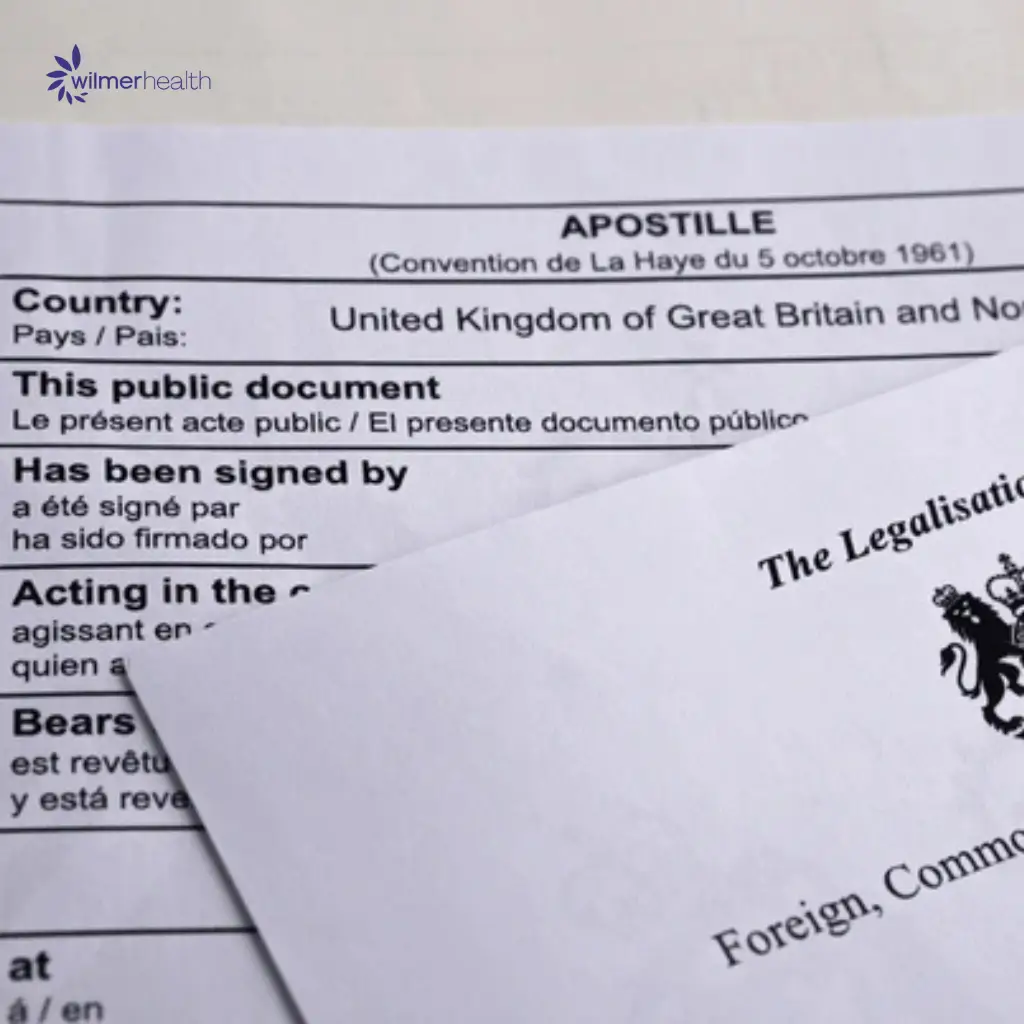
This depends on where you’re applying from.
UK applicants need an apostille on the child’s certificate, just like an adult’s. The apostille is the official FCDO stamp that makes a UK-issued document legally recognised in Spain. Without it, the consulate won’t accept the certificate. Read our full guide on how the apostille process works in the UK.
US applicants do not need an apostille for the medical certificate. Spanish consulates in the USA accept the medical certificate without additional legalisation, provided it meets the standard format requirements.
Translation works the same way for adults and children. If the certificate is in English only, it must be translated by a sworn translator officially registered with the Spanish government. If the certificate is in bilingual English-Spanish format, no separate translation is required.
For families applying together, each child needs their own apostille (UK applicants) and their own translation or bilingual certificate. The consulate requires individual documents for every applicant, no exceptions.
Getting a certificate for a child is just as straightforward as getting one for an adult. Parents or guardians complete a short online questionnaire on their child’s behalf (or with older children, alongside them), and our doctors issue the certificate in the child’s name.
Every certificate is issued in bilingual English-Spanish format as standard, which removes the translation issue for both UK and US applicants. Family orders can be processed together so all certificates arrive in date for the same consulate appointment.
For UK applicants, we handle the apostille through direct access to the FCDO counter in Milton Keynes, with guaranteed turnaround times of 4, 5, or 10 working days for the full certificate-apostille-translation package, for every family member.
For US applicants, every certificate is same-day issued, hand-signed by a licensed Medical Doctor, and shipped to your US address by priority courier. No apostille step is needed for the medical certificate.
Everything is done online, and we’re on hand seven days a week. Any questions before you apply? Drop us a message at hello@wilmerhealth.com.