
 By Dr Andrew Smith | Medical Director, Wilmer Health | Published: 11 May 2026
This guide is reviewed regularly to reflect current Spanish consulate requirements. Last updated in 2026 by Dr Andrew Smith, Medical Director, Wilmer Health. For specific advice about your individual application, contact us at hello@wilmerhealth.com.
If you’re preparing a long-stay Spanish visa application from the USA, whether for the Non-Lucrative Visa, Student Visa, Digital Nomad Visa, NALCAP, Work Visa, or Family Reunification Visa, your application will need to include a medical certificate.
It’s a small document in the context of your wider application, but it’s worth taking seriously. Of all the documents US applicants submit, this is one of the most frequently rejected, and almost always for reasons that have nothing to do with the applicant’s health.
The reason is the wording. Spanish consulates need the certificate to include specific language referencing international public health standards, and this is something most US doctors haven’t been asked to provide before. Even when they’re happy to help, the specifics can be easy to miss.
This guide walks you through the whole process, step by step, for US applicants. By the end, you’ll know exactly what your certificate needs to say, how to get one quickly, and how to avoid the mistakes that trip up hundreds of US applicants every year.
 At Wilmer Health, you can get a Spanish visa medical certificate in English and Spanish, signed today by a licensed doctor.
✓ Issued the same day, no appointment needed
✓ Issued on the official bilingual template – saving you $100+ on translation
✓ Original copy shipped to you by priority courier, anywhere in the USA
✓ Accepted at all 9 Spanish consulates in the USA
Or, if you’d like to understand the process in more detail, please read on →
The first thing to check is whether your visa needs a medical certificate at all. Short visits do not. Long-stay applications almost always do.
If you’re a US citizen traveling to Spain for tourism, business, or any visit under 90 days, you don’t need a visa, and you don’t need a medical certificate. Your US passport is sufficient.
For long-stay visas, which is to say any visa permitting a stay of more than 90 days, a medical certificate forms part of the standard documentation. The table below summarises the position for the most common visa types US applicants apply for. Please select your visa type for a more detailed guide.
Please select your visa type for a more detailed guide. If your visa isn't listed but your intended stay is over 90 days, it's reasonable to assume you'll need a medical certificate.
If your visa isn’t listed but your intended stay is over 90 days, it’s reasonable to assume you’ll need a medical certificate. Your Spanish consulate can confirm the requirements for your particular situation.
There are several specific requirements Spanish consulates look for on a medical certificate. If any of these are missing, your certificate is likely to be rejected, regardless of how strong the rest of your application is.
The certificate must clearly state that you do not suffer from any of the diseases listed under the World Health Organization’s International Health Regulations of 2005, often abbreviated to IHR 2005.
Don’t worry about the specific diseases on that list. They are rare infectious diseases such as cholera and yellow fever, all of which fall under an international framework for protecting public health. Your doctor’s role is to confirm, in line with normal medical practice, that you don’t have any of them.
But here’s the catch. The certificate must include the exact phrase “International Health Regulations of 2005.” A more general “this person is in good health” letter will not be accepted by the consulate, even if your doctor means exactly the same thing.
The wording most Spanish consulates accept reads along these lines:
“This medical certificate confirms that [Patient Name] does not suffer from any of the diseases that may have serious public health repercussions in accordance with the International Health Regulations of 2005 (IHR 2005).”
Accompanied by the equivalent in Spanish:
“Este certificado médico confirma que [Nombre del paciente] no padece ninguna de las enfermedades que pueden tener repercusiones graves para la salud pública de conformidad con el Reglamento Sanitario Internacional de 2005.”
For a more detailed breakdown of the wording, common mistakes, and why it tends to give doctors difficulty, please see our guide to the exact wording your certificate must include.
The Spanish consulate requires the certificate to be in Spanish. There are two ways of meeting this requirement:
The Spanish consulate is happy to accept either approach. The first is usually simpler and more economical, but if your circumstances make the second option more practical, that’s perfectly acceptable too. For more on the case for choosing a bilingual certificate, please see our guide to the bilingual Spanish visa medical certificate. If you’d like to see the bilingual templates currently in use, you can download all three for free.
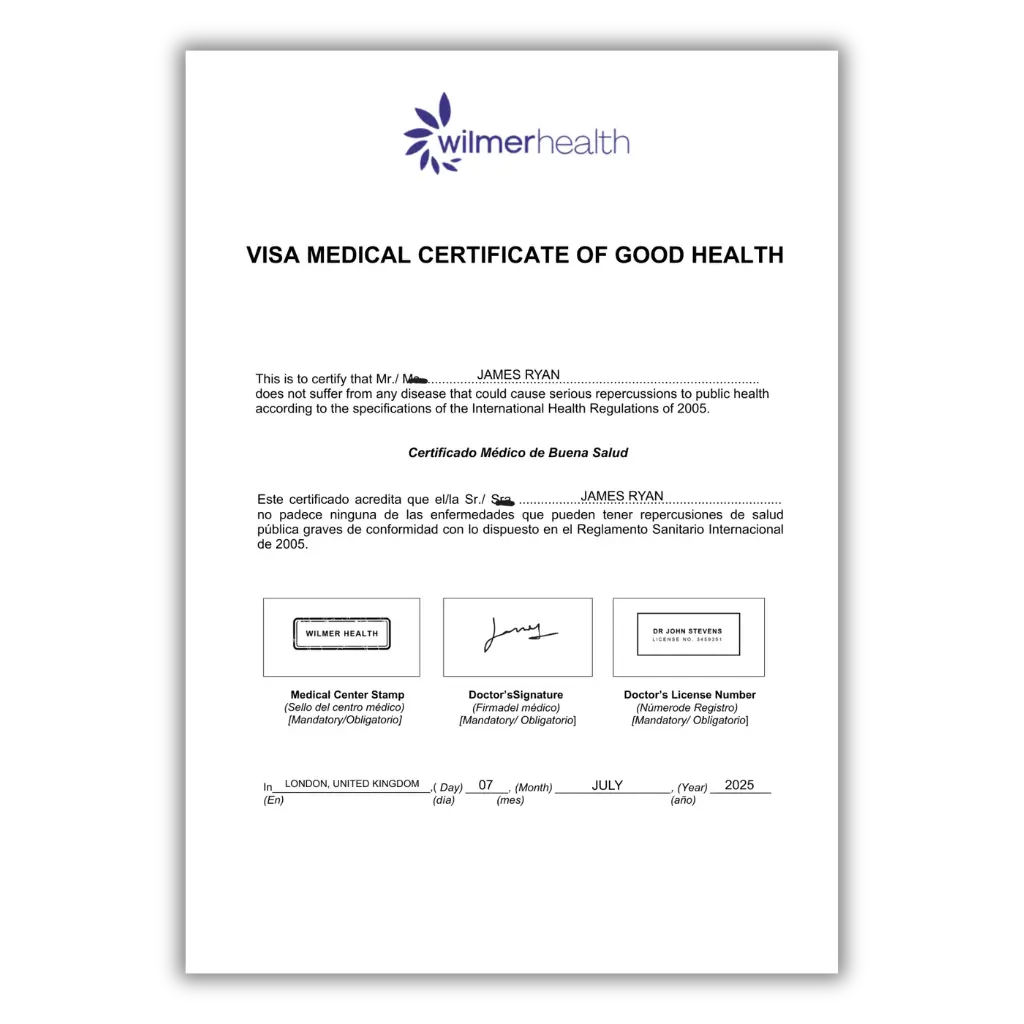
The certificate must include:
If any of these elements are missing, the consulate may reject the certificate.
The certificate is valid for 3 months from the date your doctor signs it. So if, for example, your visa appointment falls in May, your certificate must have been signed no earlier than February.
This timing catches a number of applicants out. It’s tempting to obtain the medical certificate early in your preparation, alongside the other documents, but if your consulate appointment is several months away, you may find the certificate has expired by the time you submit.
For further guidance on timing and what to do if your certificate runs out, please see our guide on how the certificate stays valid for 3 months from issue.
The name on the certificate must match your passport exactly. Avoid nicknames, shortened forms, or alternative orderings of given names and surnames. Even minor discrepancies have resulted in rejections, so it’s worth double-checking before submission.
For a complete pre-submission checklist of every requirement, see our Spanish visa medical certificate quick requirements checklist for US applicants.
Two terms come up a lot in Spanish visa research, and both confuse US applicants. Here’s what they are and whether you need them.
An apostille is a form of authentication confirming that a document is genuine for use in another country. It is issued by a government office rather than by your doctor. UK applicants generally require one for their medical certificate. US applicants generally do not.
A sworn translation is a translation prepared by a translator officially recognized by the Spanish government. It is required when your document is in English only. If your certificate is already in both English and Spanish, no sworn translation is needed.
In the USA, the Spanish visa medical certificate does not typically need an apostille. Spanish consulates in the USA generally accept a properly issued, properly worded medical certificate from a licensed doctor without this additional step.
Requirements can occasionally vary, and individual consulates may request additional documentation in specific cases. If you have any doubt about what your consulate requires, it’s always sensible to confirm with them directly before you submit.
If your medical certificate is in both English and Spanish on the same document, you won’t need a sworn translation. Choosing a bilingual certificate saves you both the translation cost (typically $100 or more) and the additional time it takes to arrange.
If your certificate is in English only, a sworn translation will need to be arranged before the consulate will accept it.

There are three main routes you can take to obtain your medical certificate in the USA. Each has its own considerations, and the right choice will depend on your circumstances.
Asking your own doctor is a perfectly reasonable starting point, particularly if you have a long-standing relationship with them. There are, however, a few practical considerations worth thinking through:
Going to your own doctor can work if you have time, a knowledgeable doctor, and you’re willing to chase the wording, signature, and translation yourself.
Specialist services focus on visa medical certificates exclusively. The process is typically:
This is what most US applicants choose because it removes nearly all the hassle. The wording is correct by default, the bilingual format is included, and the timing and price are predictable.
There are also general telehealth services and online providers that issue medical letters for various purposes. Their approach to Spanish visa medical certificates varies. Some include the IHR 2005 wording and bilingual format; others do not. Some use ink signatures; others use digital ones. If you’re considering one, it’s worth checking carefully that they meet the specific requirements covered in Step 2 above.
Issued the same day, in English and Spanish, hand-signed by a licensed doctor, shipped to you by priority courier. Accepted at all 9 Spanish consulates in the USA. $149 flat fee with money-back guarantee.
The medical certificate is one of the last documents you should get, because it’s only valid for 3 months. Get it too early and it’ll expire before your appointment.
Most US applicants order their medical certificate 2 to 4 weeks before their BLS appointment. That’s close enough that the 3-month validity isn’t at risk, but far enough ahead to leave room for any reissue or correction.

If you’ve decided to use a specialist service, here’s how the process typically works. For most US applicants, it can be completed in a single day.
Look for a service that provides:
Wilmer Health offers all of these as standard at a flat $149.
You’ll typically be asked for:
This usually takes between 5 and 10 minutes.
A licensed doctor reviews your information and prepares the certificate with the correct wording and bilingual format. With Wilmer Health and most other specialist services, the digital PDF is delivered to you the same day for your records.
The hand-signed original, on the doctor’s letterhead with stamp and license number, is shipped to your US address by tracked priority courier, typically arriving within 1 to 3 business days. This is the document you’ll bring to your consulate appointment.
Before your consulate appointment, it’s well worth taking a few minutes to verify the certificate carefully. Spotting any issue now is considerably easier than dealing with a rejection later. You should check that:
For a more detailed walkthrough of every requirement, please see our quick requirements checklist.
If you’d like to see what a correctly issued certificate looks like, alongside the essential parts you should be checking for, we’ve prepared an example for reference.
In the USA, Spanish visa applications for residents of all 50 states are handled through 9 Spanish consulates, together with the Embassy in Washington, DC, which serves as the consulate for its own area. Most consulates use a company called BLS International to manage their visa application centers.
The consulate that processes your application is determined by where you legally reside, rather than something you can choose. The Spanish consulates and the states they cover are as follows:
The Spanish visa medical certificate is one of the more straightforward documents in your application, provided it’s done correctly. The key elements are the correct wording, both languages on the document, a hand-signed original, and submission within the 3-month window.
At Wilmer Health, we issue Spanish visa medical certificates for US applicants every day. Same-day issuance, in both English and Spanish, hand-signed by a licensed doctor, and shipped to you by priority courier. We’re accepted at all 9 Spanish consulates in the USA. Our service is $149 flat fee with a money-back guarantee.