
 By Dr Andrew Smith | Medical Director, Wilmer Health | Published: 13 May 2026
This guide is reviewed regularly to reflect current Spanish consulate requirements. Last updated in 2026 by Dr Andrew Smith, Medical Director, Wilmer Health. For specific advice about your individual application, contact us at hello@wilmerhealth.com.
If you’re applying for a Spanish student visa from the USA, whether for a semester abroad, a full degree program, NALCAP, or a language course, you may need to include a medical certificate as part of your application.
The student visa is one of the most popular Spanish long-stay visas for US applicants, and it has a few quirks worth knowing about. Some of the trickier ones are specific to students: the timing puzzle between when you can apply and when your certificate expires, the question of whether your college health center can write the certificate, and the specific situation of NALCAP applicants who are technically applying for a student visa.
This guide covers what US student applicants specifically need to know. For the universal requirements (wording, format, where to get a certificate), check out our complete guide on how to get a Spanish visa medical certificate from the USA. This article focuses on what’s specific to student visa applicants.
 At Wilmer Health, you can get a Spanish visa medical certificate in English and Spanish, signed today by a licensed doctor.
✓ Issued the same day, no appointment needed
✓ Issued on the official bilingual template – saving you $100+ on translation
✓ Hand-signed by a licensed doctor (MD)
✓ Original copy shipped to you by priority courier, anywhere in the USA
✓ Accepted at all 9 Spanish consulates in the USA
Or, if you’d like to understand the process in more detail, please read on →
If you’re studying in Spain for more than 90 days, you’ll need a student visa. And that student visa application requires a medical certificate. It’s that simple:
This covers all the most common student programs: semester-abroad placements, full academic year programs, master’s and PhD studies, language courses, training programs, and NALCAP placements.
If you’re a student visa holder and your spouse, civil partner, or dependent children are coming with you to Spain, they’ll need their own visa applications and their own medical certificates.
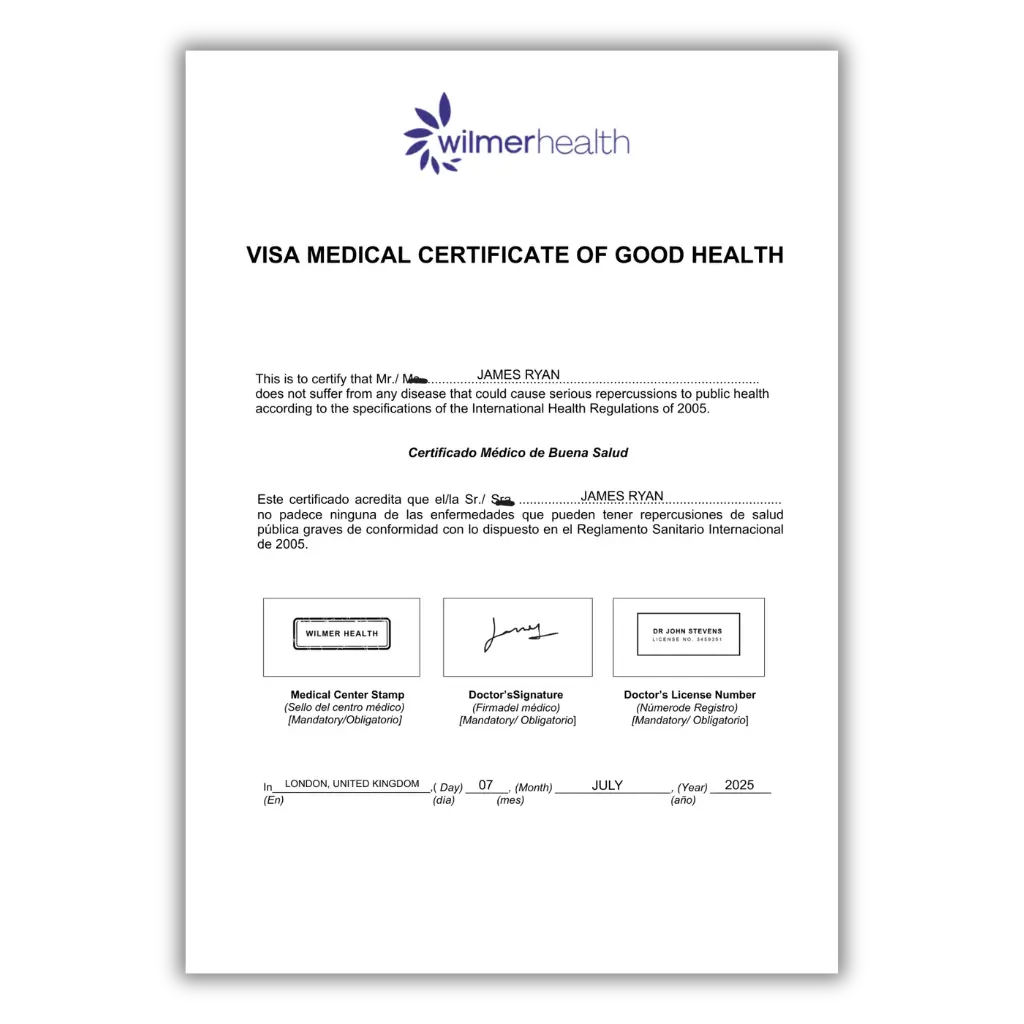
In most respects, the medical certificate for a student visa is the same as the certificate for any other Spanish long-stay visa. It needs to reference the International Health Regulations of 2005, it needs to be in both English and Spanish (or come with a sworn translation), and it needs to be hand-signed by a doctor. For the full requirements, see our Spanish visa medical certificate requirements checklist.
There are, however, two things worth flagging for student applicants.
Spanish consulates are clear on student visa applications that the medical certificate must be signed by a Doctor (Physician), specifically a Medical Doctor (MD) or Doctor of Osteopathic Medicine (DO). The requirement is stated clearly: “The certificate must be signed by a Doctor (Physician), not by a Nurse Practitioner or a Physician Assistant.”
This matters especially for US students because many college health centers and walk-in clinics are staffed wholly or partly by Nurse Practitioners (NPs) and Physician Assistants (PAs). A certificate signed by an NP or PA, no matter how well-written, will be rejected by the consulate.
If you’re thinking about using your campus health center, confirm in advance that the person signing your certificate will be an MD or DO. If they aren’t, you’ll need to look elsewhere.
The medical certificate is only valid for 3 months from the date your doctor signs it. So if your visa appointment is in May, the certificate must have been signed no earlier than February.
Here’s the only timing rule that really matters: order your medical certificate 2 to 4 weeks before your BLS appointment, not earlier.
The reason: the certificate is only valid for 3 months from the date it’s signed. Student visa applications can be submitted as early as 6 months before your program start, but if you order your medical certificate that far ahead, it will have expired by the time you submit. Ordering it shortly before your appointment keeps you comfortably within the validity window with room for a reissue if anything needs correcting.
If you’re applying for a fall semester program, be aware that BLS appointment availability tightens significantly between June and August due to high demand. Book your appointment early, and then time your medical certificate around it.

If you’re applying for a NALCAP placement (Auxiliares de Conversación), you’re officially applying for a Spanish student visa. Spain’s Ministry of Education confirms this directly: NALCAP participants apply for what they call a “Student/Study National Visa.”
This means everything in this guide applies to you. The medical certificate requirements are the same as any other student visa: same wording, same bilingual format, same MD/DO signature, same 3-month validity.
NALCAP applicants do have some specific timing considerations around the PROFEX placement process and the Placement Letter (Carta de Nombramiento). For the full NALCAP-specific guide, including timing, consulate routing, and what to expect after placement, see our NALCAP medical certificate guide for US applicants.
The question of where to actually get the medical certificate is one of the most common starting points for US student applicants. The options are essentially the same as for any other Spanish long-stay visa, but with a few student-specific things to know.
This is often the first place US students think of, especially if you’re still on campus when you start your application. There are two warnings worth raising:
If you want to use your campus health center, it can work, but come prepared with the official bilingual templates used by US Spanish consulates and confirm both the MD signature and that the doctor will use the correct phrasing
If you have a long-standing relationship with a primary care doctor at home, asking them is reasonable. The same warnings apply: confirm in advance they’re willing to use the specific IHR 2005 wording, that they’re an MD or DO, and that they’re comfortable producing the certificate on letterhead with their stamp and signature.
If they are unwilling to complete a bilingual template, you’ll also need to arrange a sworn translation separately.
This is the route most US student applicants choose, especially when timing is tight. Specialist services like Wilmer Health issue the certificate same-day in both English and Spanish, hand-signed by a licensed doctor, and ship the original to your US address by priority courier. The wording is consulate-approved as standard, so there’s no need to coordinate the IHR 2005 reference yourself.
A few general telehealth and “letter writing” services offer Spanish visa medical certificates. Quality varies a lot. If you’re considering one, check carefully that they provide the IHR 2005 wording, the bilingual format, an MD signature, and a hand-signed (not digital) original.
Drawing from the patterns we see across thousands of US applications, here are the more common mistakes specific to student visa applicants.
Already covered above, but worth restating because it’s genuinely common. US students often turn to their campus health center or a nearby walk-in clinic, where the available provider may be an NP or PA. The Spanish consulate explicitly requires an MD or DO signature. Always confirm before booking.
Student applicants often want to gather everything as soon as possible. Usually that’s smart, but the medical certificate is different. Because it’s only valid for 3 months, getting it in January for a May appointment means it will have expired by the time you submit. Order this document 2 to 4 weeks before your BLS appointment, not earlier.
For students traveling to Spain with a spouse, civil partner, or dependent children, each family member needs their own visa application and their own medical certificate. This is sometimes a late surprise that causes scheduling problems.
NALCAP applicants are sometimes told (or assume) that the program has its own specific requirements separate from the regular student visa. From a medical certificate perspective, this isn’t true. NALCAP is officially a student visa, with the same medical certificate requirements as any other student visa.
The Spanish consulate requires the certificate to reference the International Health Regulations of 2005 explicitly. A doctor who writes “this patient is in good health and fit to travel,” no matter how accurate, will produce a certificate the consulate can’t accept. The IHR 2005 reference is the part that makes the certificate work.
For more on the exact wording and common mistakes, see our guide to the exact wording your certificate must include.
If you’ve decided a specialist service is the right route for you, the process is straightforward and can typically be done in a single day. In brief, the steps are:
If you’d like to see what your finished certificate should look like, take a look at our Spanish visa medical certificate example.
For most US student visa applicants, the medical certificate is one of the easier documents to handle, provided you know about the MD/DO signature requirement and time the 3-month validity window correctly. If you’re using a specialist service, the certificate itself can be sorted in a single day.
If you’d like us to handle yours, our US service is $149 flat fee, same-day, hand-signed by a licensed doctor, and shipped to your US address.