
By Dr Andrew Smith | Medical Director, Wilmer Health | Published: 15 May 2026
This guide is reviewed regularly to reflect current Spanish consulate requirements. Last updated in 2026 by Dr Andrew Smith, Medical Director, Wilmer Health. For specific advice about your individual application, contact us at hello@wilmerhealth.com.
If you’re applying to the North American Language and Culture Assistants Program (NALCAP), the medical certificate is one of the documents you’ll need for your Spanish visa. It’s a straightforward document on paper, but it has specific requirements that catch out a fair number of US applicants, especially recent grads applying for the first time.
This guide covers what NALCAP applicants specifically need to know about the medical certificate. For the general guide on how to get a Spanish visa medical certificate from the USA, see our complete guide for US applicants.
The NALCAP program has experienced regional cancellations and delays to recent application cycles. This guide focuses on the medical certificate requirements, which apply consistently across all program years. Check the official NALCAP page for current application status.
At Wilmer Health, you can get a Spanish visa medical certificate in English and Spanish, signed today by a licensed doctor.
✓ Issued the same day, no appointment needed
✓ Issued on the official bilingual template – saving you $100+ on translation
✓ Hand-signed by a licensed doctor (MD)
✓ Original copy shipped to you by priority courier, anywhere in the USA
✓ $149 flat fee, with a money-back guarantee
✓ Accepted at all 9 Spanish consulates in the USA
Or, if you’d like to understand the process in more detail, please read on →
NALCAP participants are officially classified as Spanish student visa applicants. Spain’s Ministry of Education confirms this directly: NALCAP applicants apply for what they call a “Student/Study National Visa.”
This matters because the medical certificate requirements for NALCAP are identical to those for any other Spanish student visa. Same wording, same signature requirements, same validity rules, same bilingual format.
If you want the broader picture of how the medical certificate fits into a Spanish student visa application, see our Spanish student visa medical certificate guide for US applicants. The current guide focuses on what’s specifically useful for NALCAP applicants.
Yes. A medical certificate is required as part of your Spanish student visa application, which is the visa NALCAP participants apply for. Without it, your application will not be processed.
The certificate must meet the same standards as any Spanish long-stay visa medical certificate:
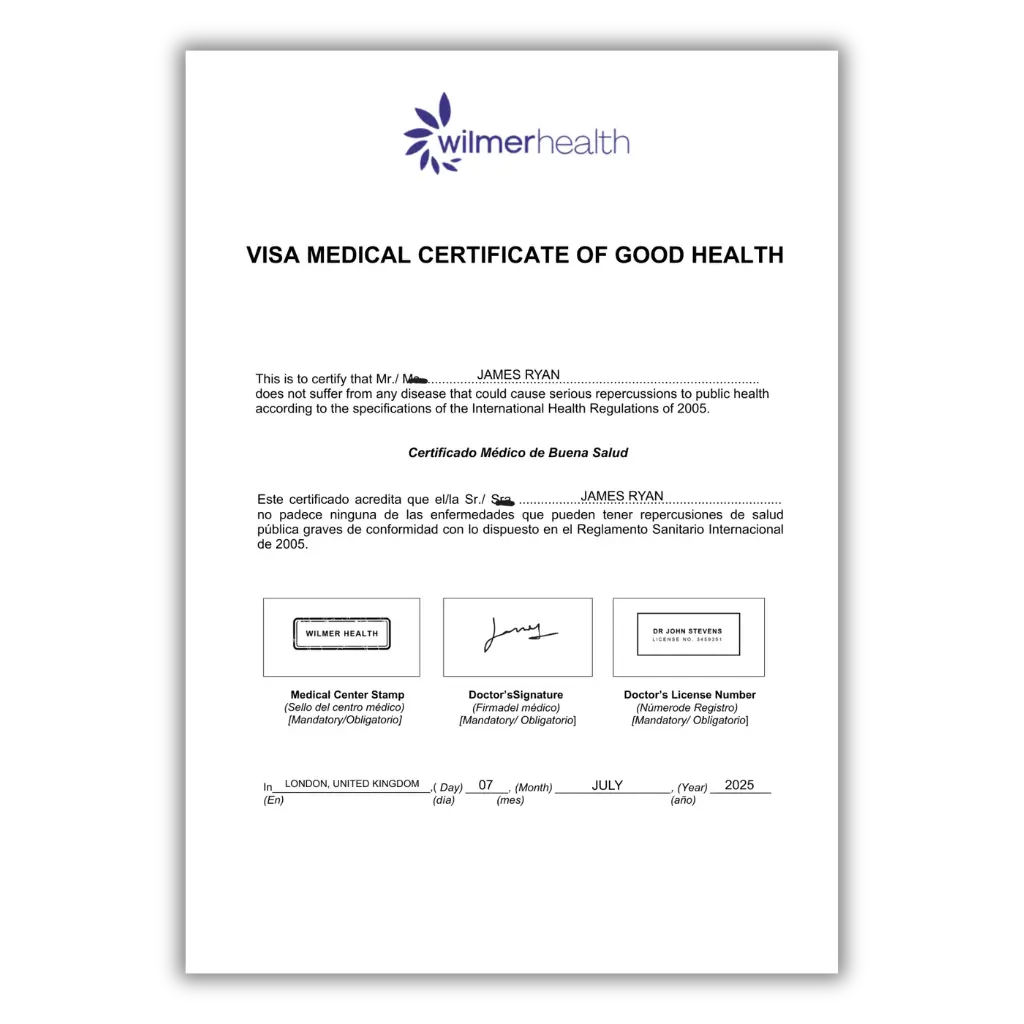
For the full breakdown of each requirement, see our Spanish visa medical certificate requirements checklist. To see what a finished certificate looks like with all of these elements in place, see our annotated certificate example.
If you’d like to see the actual bilingual templates that US Spanish consulates accept, we’ve made the three currently in use available to download.
Spanish consulates explicitly require the certificate to be signed by a Doctor (Physician), specifically a Medical Doctor (MD) or Doctor of Osteopathic Medicine (DO). A certificate signed by a Nurse Practitioner (NP) or Physician Assistant (PA) will be rejected, regardless of how well the rest of it is prepared.
This is worth flagging because many US walk-in clinics, urgent care centers, and college health services are staffed wholly or partly by NPs and PAs. NALCAP applicants are a mixed group: some are current college students, some are recent grads, some are mid-career or older applicants. Whichever group you’re in, make sure that if your certificate is signed by anyone, it’s by an MD or DO.
If you’re a current college student or recent grad still using a campus health service, confirm in advance that an MD or DO will be signing your certificate.
The medical certificate is valid for 3 months from the date it’s signed. The certificate must still be in date when you submit your visa application at your BLS appointment.
The practical rule: order your medical certificate 2 to 4 weeks before your BLS appointment, not earlier.
For NALCAP applicants, the application process generally follows a sequence:
The Placement Letter is the document that confirms your assigned school and is required for the visa application. You won’t typically need your medical certificate until after the Placement Letter arrives.
Once you have a confirmed BLS appointment, count back 2 to 4 weeks and that’s roughly when to order your certificate. Earlier than that, and you risk it expiring before submission.
You have three realistic options.
If you have an established relationship with a primary care doctor who’s willing to sign the certificate using the IHR 2005 wording, this can be a workable option. The checks: MD or DO signature, specific wording, official letterhead, and bilingual format (or you’ll need to arrange a sworn translation separately).
If you’re a current college student or recent grad still with access to your campus health service, this is sometimes a starting point. Two cautions:
If both check out, this can work. If either doesn’t, you’ll need to look elsewhere.
This is the route many NALCAP applicants choose when their PCP or campus health service isn’t an option. Specialist services like Wilmer Health issue certificates the same day, in bilingual format, hand-signed by a licensed MD, with the original shipped to your US address by priority courier.
If you’ve decided a specialist service is the right route for you, the process can be done in a single day. In brief:
For most NALCAP applicants, the medical certificate is one of the more straightforward parts of the visa application. The two things to get right are the MD or DO signature requirement and the timing relative to your BLS appointment. Both are easy to handle with a specialist service.
If you’d like us to handle yours, our US service is $149 flat fee, same-day, hand-signed by a licensed doctor, and shipped to your US address.