
 Libbie Stevens | Visa Advisor, Wilmer Health | Published: 6 May 2026
This guide is for informational purposes only and reflects requirements as understood in 2026. Visa requirements can vary by consulate and are subject to change. Always confirm specific requirements with the Spanish consulate or immigration authority handling your application. For specific advice about your individual application, contact us at hello@wilmerhealth.com.
If you’re applying for a Spanish visa from the UK, you’ve probably been told your documents need an “apostille” — and quickly realised it’s one of the more confusing parts of the process.
Which documents need one? Which don’t? Does the apostille itself need translating? What about bank statements? How do you actually get one, and how long does it take?
This guide answers all of it. It’s written specifically for UK applicants applying for a Spanish visa, with up-to-date 2026 information, and covers the common mistakes that delay or sink applications.
An apostille is an official stamp that proves a UK document is genuine, so it can be used in another country. In the UK, apostilles are issued by the Legalisation Office, which is part of the Foreign, Commonwealth & Development Office (FCDO).
Key features:
Without an apostille, Spanish authorities won’t accept most official UK documents. It’s a non-negotiable step for almost every visa applicant.
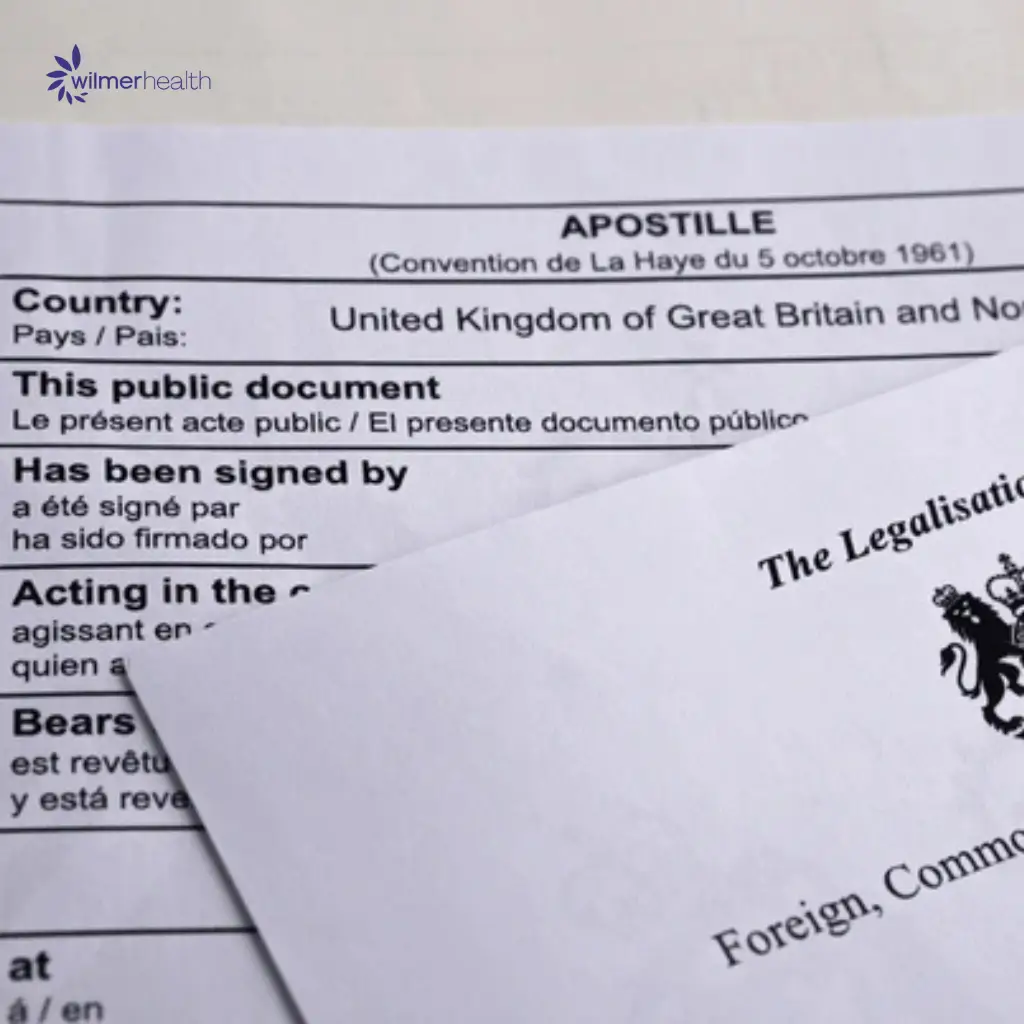
Yes, in almost all cases. If you’re submitting a UK government-issued document — birth certificate, marriage certificate, ACRO police certificate, medical certificate, degree certificate — to a Spanish consulate, it must be apostilled.
The exception is documents that aren’t government-issued (bank statements, employer letters, insurance certificates), which can’t be apostilled and don’t usually require one. We cover these in the next section.
The UK Legalisation Office will only apostille what’s called a public document. In plain terms: a document issued by a UK government body (like the General Register Office or ACRO) or signed by a UK official whose signature is on the FCDO’s records.
Documents that can be apostilled:
| Document | Why it qualifies |
|---|---|
| Birth, marriage, death certificates | Issued by the UK General Register Office (GRO) |
| ACRO police certificate | Issued by ACRO Criminal Records Office |
| Spanish visa medical certificate | Signed by a UK doctor registered with the General Medical Council (GMC), whose signature is on the FCDO's records |
| Degree certificates and academic transcripts | Apostilled after a solicitor or notary public has confirmed they're genuine (more on this below) |
| FCDO and HMRC documents | Issued by central UK government |
| Court documents | Signed by a UK court official |
Documents that can’t be apostilled directly:
| Document | Why it doesn't qualify |
|---|---|
| Bank statements | Issued by a private bank, not a government body |
| Employer letters | Issued by a private company |
| Insurance certificates | Issued by a private insurer |
| Tenancy agreements | Private contract |
| Utility bills | Private commercial document |
The workaround for private documents. A UK solicitor or notary public can sign a statement confirming the document is genuine, and the apostille is then added to that signed statement (not to the document itself). A solicitor is a qualified UK lawyer; a notary public is a specially-authorised lawyer who handles official document verification.
That said, bank statements and similar financial proofs are usually accepted by Spanish consulates without an apostille, just as originals or with a bank stamp. Don’t pay for solicitor certification on these unless your specific consulate’s guidance asks for it.
If your consulate’s published guidance is unclear about a specific document, contact them before paying for unnecessary certification.
The exact list depends on the visa type. The most common requirements:
| Document | Common visas requiring it | Apostille needed? |
|---|---|---|
| ACRO police certificate | All long-stay visas (NLV, Student, DNV, Work) | Yes, mandatory |
| Medical certificate | All long-stay visas | Yes, mandatory |
| Birth certificate | Family reunification, dependent children visas | Yes, mandatory |
| Marriage certificate | Spouse visas, family reunification | Yes, mandatory |
| Degree certificate | Student Visa, Work Visa, Digital Nomad Visa (sometimes) | Yes, with solicitor certification first |
| Bank statements | Non-Lucrative Visa, Student Visa, DNV (financial means) | Usually no — accepted as-is |
| Employer letter / contract | Work Visa, DNV, family reunification | Sometimes — varies by consulate |
| Certificate of Good Standing (for company) | DNV (UK company employees) | Yes |
Requirements vary slightly between the Spanish consulates in London, Manchester, and Edinburgh, so always cross-check your specific consulate’s published guidance.
UK birth certificates issued by the General Register Office can be apostilled directly without solicitor certification. Spanish authorities typically require:
For full detail, see our birth certificate apostille for Spain guide.
UK marriage certificates from the General Register Office are apostilled directly. Required for spouse visas, family reunification, and any application where you’re declaring marital status to Spanish authorities.
Same freshness rule applies: most consulates want a newly-issued certificate dated within 3 months. Order a fresh certified copy from the GRO before requesting the apostille.
Degrees are more complicated than other documents. Unlike a birth certificate (which the FCDO can apostille directly), a UK degree certificate isn’t signed by a government official — so the FCDO can’t apostille it on its own.
The standard route for a UK degree to be used in Spain:
For Spanish professional recognition — known as homologación (full recognition of the degree as equivalent to a Spanish one) or declaración de equivalencia (recognition at a general level) — you may also need to deal with Spain’s Ministry of Education process. See our UK degree apostille for Spain guide for the full process.
ACRO certificates are issued by the ACRO Criminal Records Office and are apostilled by the FCDO based on the ACRO officer’s signature. ACRO is the only UK criminal records certificate accepted by Spanish authorities — DBS certificates are not accepted. See our ACRO certificate apostille guide for the full process.
For the FCDO to apostille a medical certificate, the doctor who signed it must be registered with the General Medical Council (GMC) — and crucially, their signature must already be on the FCDO’s records. This isn’t automatic. Many GPs aren’t on the FCDO’s database, which means the apostille can be delayed or rejected, even if the doctor is fully qualified.
At Wilmer Health, every doctor who issues a Spanish visa medical certificate has their signature already registered with the FCDO, so the apostille goes through smoothly. Our medical certificate also comes in bilingual format — English and Spanish on the same document — so no separate sworn translation is needed.
A common point of confusion: apostille and sworn translation are two separate requirements, and most UK documents need both.
One important exception: bilingual documents. A document that’s already issued in English and Spanish on the same page (like Wilmer Health’s bilingual Spanish visa medical certificate) still needs an apostille on the original — but skips the sworn translation step entirely, because the Spanish version is already there. This isn’t common, but where it’s available, it removes one of the most expensive and time-consuming steps of the process.
In our experience, no. Spanish consulates in the UK accept a UK-issued Hague Apostille as-is, without requiring a separate sworn translation of the apostille certificate itself.
That said, requirements occasionally vary between consulates, and some translators include the apostille translation as standard — particularly when the apostille has additional handwritten or English-language details that affect interpretation.
Always check your specific consulate’s published requirements before submitting. This guide reflects our practical experience and current consulate practice, but rules can change without notice and individual cases vary. Wilmer Health can’t accept responsibility for application outcomes based on guidance that doesn’t match your consulate’s specific requirements at the time of your application.
This is genuinely contested. Some sources insist apostille first; others point out the apostille is multilingual, so the order doesn’t really matter. In practice, both orders are accepted by Spanish consulates in most cases.
For full detail on sworn translation — what it is, who can produce one, and why UK certified translators (CIOL/ITI) aren’t accepted by Spanish consulates — see our Spanish sworn translation guide for UK visa applicants.
Most Spanish consulates require documents (and their apostilles) to be dated within 3 months of your visa application.
This is one of the most common mistakes UK applicants make: they apostille a birth or marriage certificate from years ago, only to be told at their consulate appointment that the certificate is too old.
The fix is simple but easy to miss: order a freshly-issued copy of the certificate before requesting the apostille. UK General Register Office certificates can be reordered online — they’re not “lost” or “replaced,” they’re freshly-issued certified copies of the same record.
Documents this rule applies to:
Documents this rule doesn’t apply to (because they’re inherently dated):
When you plan your application timeline, work back from your consulate appointment date and make sure no document or apostille will be older than 3 months when you submit.

There are two routes for the public: applying directly to the FCDO yourself, or using a UK apostille service. The fast-track options the FCDO publishes (“Next-Day” and “Restricted Urgent”) are restricted to registered businesses with direct counter access — they’re not available to individual applicants.
Apply directly to the UK Legalisation Office through the FCDO website. You either post your document in or, for some document types, upload it through the e-Apostille online service.
The standard postal service is the cheapest route, but the timeline is the biggest risk for visa applicants. If your consulate appointment is less than a month away, the standard service is rarely safe to rely on.
A specialist apostille service can deliver in a fraction of the time because they have direct counter access at the FCDO Legalisation Office in Milton Keynes. Instead of posting documents in and waiting in the standard queue, they submit and collect documents in person, often returning apostilled documents the next working day.
This is the practical advantage that matters: it’s not just a “convenience” service, it’s a genuinely different processing route.
At Wilmer Health:
For visa applicants with consulate appointments, the apostille service route is usually the right call. The FCDO standard timeline of “up to 15 working days” rarely stays at 15 days during peak periods — and a delayed apostille can mean a missed appointment and a rebooking that’s weeks away.
Wilmer Health provides UK apostille services for Spanish visa applicants — and we have direct counter access at the FCDO Legalisation Office in Milton Keynes. That’s the meaningful difference: instead of posting your document into the FCDO’s standard queue and waiting 15+ working days, we can process apostilles at the counter, often obtaining them next-day.
What’s included:
The FCDO’s published “up to 15 working days” routinely runs longer in busy periods — especially summer (June-August) and around Christmas. For visa applicants with fixed consulate appointments, that’s a real risk: a delayed apostille can mean a missed appointment and a rebooking weeks away.
If you’ve got a consulate appointment coming up and you can’t risk the standard postal queue, we can help. Send us your document, we’ll get it apostilled at the FCDO Milton Keynes counter, and post it back to you ready to submit.
Yes, in almost all cases. Any UK government-issued document submitted to a Spanish consulate — birth certificate, marriage certificate, ACRO certificate, medical certificate, degree certificate — must be apostilled by the FCDO Legalisation Office.
Usually no. FCDO apostilles follow a multilingual Hague Convention format that Spanish authorities recognise. Some translators include the apostille translation as standard, but it’s not typically required as a separate step.
No. Bank statements are private commercial documents and aren’t issued by a public body, so they can’t be apostilled directly. Spanish consulates usually accept bank statements as-is, sometimes with a bank stamp or letter of confirmation.
The FCDO standard fee is £45 per document for a paper apostille or £35 for an e-Apostille (2026 fees), plus courier or postage. Through a UK apostille service like Wilmer Health, end-to-end pricing is £85 for standard processing, with fast-track options available. A typical Spanish visa document set costs £300-£600 for apostilles alone.
The FCDO’s standard service is officially “up to 15 working days,” but in practice this often runs longer during busy periods (summer and around Christmas). Apostille services with direct FCDO counter access — like Wilmer Health — can deliver apostilles in 7-10 working days as standard, or 3-4 working days with the fast-track option.
Yes, for almost all documents. The apostille legalises the original; the sworn translation makes it readable in Spanish. Most UK visa documents need both.