
 Libbie Stevens | Visa Advisor, Wilmer Health | Published: 8 May 2026
This guide is for informational purposes only and reflects requirements as understood in 2026. Visa requirements can vary by consulate and are subject to change. Always confirm specific requirements with the Spanish consulate or immigration authority handling your application. For specific advice about your individual application, contact us at hello@wilmerhealth.com.
If you have your ACRO Police Certificate in hand and are wondering what comes next, the apostille is the step that catches a lot of people off guard. It is not something most people have come across before, and the word itself does not make it immediately obvious what it is or why it is needed.
The short answer is yes — your ACRO certificate needs a UK Hague Apostille before a Spanish consulate will accept it. But understanding what the apostille actually is, how to get it, and where it fits in the process will save you time and help you avoid one of the most common mistakes in the Spanish visa application process.
For a complete overview of everything the ACRO certificate involves for a Spanish visa, see our complete UK guide to the ACRO certificate for a Spanish visa.
An apostille is a form of official legalisation that confirms a document is genuine. It is issued under an international agreement that allows official documents from one country to be recognised as authentic by another — without needing to go through a much more lengthy legalisation process.
In the UK, apostilles are issued by the Foreign, Commonwealth and Development Office (FCDO). When the FCDO apostilles your ACRO certificate, it is essentially confirming to the Spanish authorities that the document is a genuine, official UK public document — and that the signature and seal on it are authentic.
Without the apostille, there is no way for the Spanish consulate to verify that your ACRO certificate is legitimate, which is why it will not be accepted without one.
Because Spain and the UK are both part of an international agreement, UK documents submitted for official use in Spain need to carry the apostille to be recognised as genuine. It is not unique to the ACRO certificate — birth certificates, marriage certificates, and medical certificates submitted as part of a Spanish visa application all typically need one too. For the ACRO certificate specifically, every Spanish consulate in the UK requires it.
The apostille is a separate page or stamp that is physically attached to your original ACRO certificate. It bears the FCDO stamp and an authorised signature, and it will typically include a reference number and the date it was issued.
It travels with your certificate as one document — the apostille and the ACRO certificate together are what you present to the consulate, not the apostille separately.
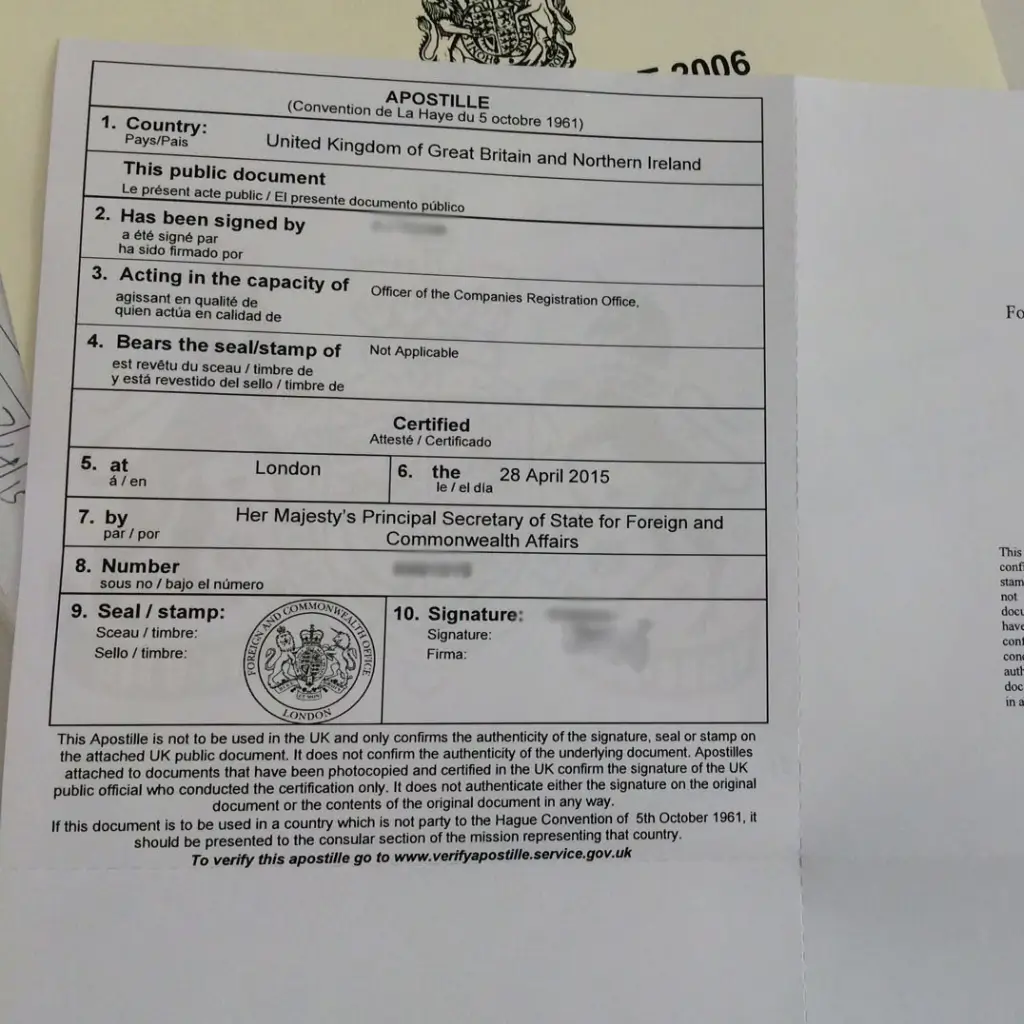
The apostille must be attached to the original ACRO certificate as issued — not a photocopy, scan, or duplicate. This is a point that trips people up more often than you might expect.
If you have photocopied your certificate and sent the copy for apostilling, the resulting document will not be accepted by the Spanish consulate. Keep your original certificate safe from the moment it arrives and make sure it is the original that is submitted for legalisation.
There are two ways to obtain the FCDO apostille for your ACRO certificate.
Applying directly to the FCDO — members of the public can submit their original ACRO certificate to the FCDO for apostilling via the standard postal service, which costs £45 per document and typically takes up to 20 working days — though this can stretch further during busy periods in spring and summer. It is worth noting that the FCDO’s faster services are only available to registered apostille agents, not to the general public directly. If you apply yourself, the standard postal route is your only option.
Using a managed service — Wilmer Health handles the apostille as part of our fully managed ACRO certificate service. With our direct counter access to the FCDO Legalisation Office in Milton Keynes, we can obtain your apostille significantly faster than the public postal route — in as little as 4 working days. We coordinate everything in the correct sequence alongside your certificate application, and it is all included in our £345 package. If you already have your ACRO certificate and just need the apostille arranged, we also offer a standalone apostille service for Spanish visa documents.
If you apply directly to the FCDO as a member of the public, the standard postal service typically takes up to 20 working days — and can slow down further during busy periods in spring and summer. If you use a registered apostille agent with direct FCDO counter access, like Wilmer Health, the process can be completed in as little as 4 working days.
Factor the apostille into your overall timeline when planning around your consulate appointment. Combined with the time to obtain the ACRO certificate itself, you need to make sure everything is completed and in your hands well within the six-month validity window that Spanish consulates require. Our 2026 ACRO certificate requirements checklist has a full breakdown of what needs to be in place before you submit.

Apostilling a copy instead of the original. As mentioned above — the apostille must go on the original certificate, not a copy.
Submitting without an apostille at all. It sounds obvious, but it happens — usually when someone has run out of time before their consulate appointment. An ACRO certificate without an apostille will be rejected. Our guide to why ACRO certificates are rejected for Spanish visa applications covers this and other common reasons for rejection.
Confusing the apostille with notarisation. A notarised copy is not the same as an apostilled original. Notarisation is a different process used in a different context — it will not satisfy the Spanish consulate’s apostille requirement.
Yes, your ACRO certificate needs a UK Hague Apostille before it will be accepted for a Spanish visa application. The apostille is issued by the FCDO, must be attached to the original certificate, and needs to be in place before your documents are ready for consulate submission.
If you want the apostille handled as part of a fully managed process — alongside your ACRO certificate application and delivery — Wilmer Health’s ACRO certificate service covers everything for £345, completed within 12 working days.