
 By Dr Andrew Smith | Medical Director, Wilmer Health | Published: 21 April 2026
This guide is reviewed regularly to reflect current Spanish consulate requirements. Last updated April 2026 by Dr Andrew Smith, Medical Director, Wilmer Health. For specific advice about your individual application, contact us at hello@wilmerhealth.com.
You’ve got the job offer. You’ve negotiated the contract. And now you’re working through the document checklist for your Spanish work visa, trying to make sure nothing delays your start date. The medical certificate is one of those documents that’s easy to underestimate — it looks straightforward on the list, but get it wrong and it can hold up the whole application at exactly the wrong moment.
This guide covers everything specific to work visa applicants in the UK — which visa routes need a medical certificate, what it has to include, how to time it around the employer-led application process, and how to get it sorted without it becoming a problem. For the full picture on how the medical certificate works in general, head to our complete guide — Spanish Visa Medical Certificate in the UK: Everything You Need to Know (2026). This page focuses specifically on what’s relevant to you as a work visa applicant.
Most Spanish long-stay work visa routes require a medical certificate as part of the application. The main routes UK applicants apply for include:
Employee Visa (Cuenta Ajena): The standard route for those with a job offer from a Spanish employer. Your employer applies for work authorisation first, and once approved, you apply for the visa — which includes the medical certificate.
Highly Qualified Professional Visa: For professionals with a university degree or significant experience being recruited by a Spanish company. Same medical certificate requirement applies.
Intra-Company Transfer: For employees being relocated to a Spanish office of their existing employer. Again, the medical certificate is a standard part of the document pack.
Self-Employed Visa (Cuenta Propia): For those setting up as self-employed in Spain. The medical certificate requirement is the same as for employed routes.
If you’re not sure which route applies to you, your employer or a Spanish immigration lawyer will be able to confirm — but in almost every case, the medical certificate requirement is the same across all of them.
No. The medical certificate required for a Spanish work visa is exactly the same document as the one required for an NLV, Student Visa, Digital Nomad Visa, or any other Spanish long-stay visa. Same wording, same format, same doctor requirements. What differs is the application process around it — particularly the timing, which we’ll come to shortly.

The certificate needs to be issued by a GMC-registered, FCDO-verified doctor, signed in wet ink, stamped, and on official headed paper. Most importantly, it needs to include the exact wording required by Spanish immigration authorities — a reference to the International Health Regulations (2005) that confirms you don’t carry any disease posing a serious public health risk.
A generic letter from your GP saying you’re in good health won’t be accepted. The wording has to be right. Read our full guide on what your Spanish visa medical certificate should say for the exact requirements.
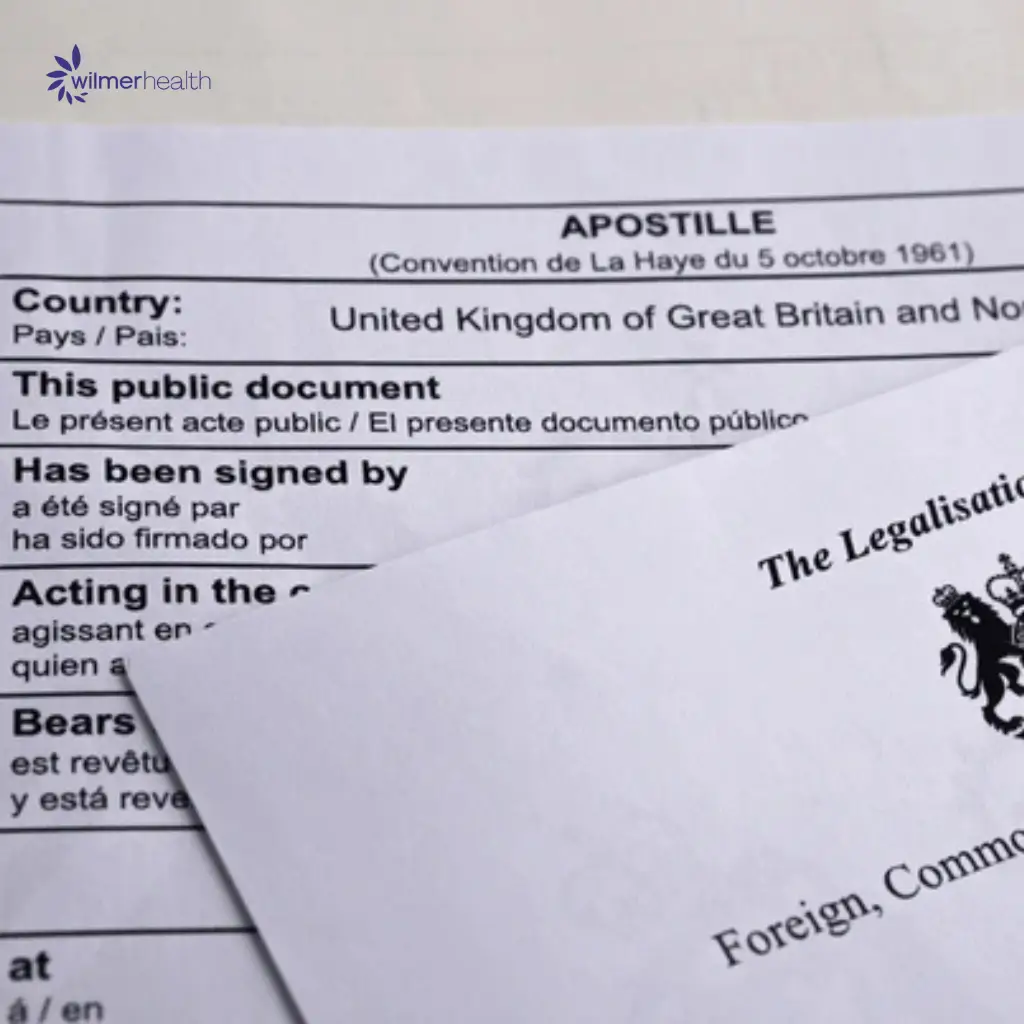
One of the most common reasons work visa medical certificates cause delays isn’t the certificate itself — it’s what happens afterwards. Submitting a certificate without an apostille, or with an informal rather than sworn translation, will result in rejection regardless of how well the certificate itself has been prepared.
Your certificate needs two things before it can be submitted to the Spanish consulate. First, an apostille — the official FCDO stamp that legalises your UK-issued document for use in Spain.
Second, a sworn translation into Spanish, carried out by a translator registered with the Spanish government. These must happen in the right order: apostille first, then translation.
For work visa applicants with a fixed start date, turnaround time matters. Using a provider that handles the certificate, apostille, and translation together — as Wilmer Health does — removes the risk of delays caused by coordinating multiple providers. Our certificates are also issued in bilingual format as standard, which means the translation is already included, saving you typically £75 and several days of waiting.
Read our full guides on how to get an apostille for your Spanish visa medical certificate and getting your certificate translated in the UK for more detail.
This is the aspect of the work visa application that catches most people out, and it’s genuinely specific to work visa applicants.
Unlike the NLV or Student Visa where you drive the application yourself, most Spanish work visas follow an employer-led process. Your employer applies to the Spanish immigration authorities for work authorisation first — a process that typically takes one to two months. Only once that authorisation is granted can you apply for the visa itself, which is when you submit your medical certificate.
The timing implication is significant: your medical certificate is valid for three months from the date of issue. If you get it too early — before work authorisation comes through — it could expire before you’re able to submit your visa application. If you get it too late, you’re adding unnecessary pressure to an already tight timeline.
The practical approach is to wait until work authorisation is confirmed before getting your medical certificate. Once you have authorisation in hand, aim to get the certificate sorted within the first week — giving yourself enough time for the apostille and translation before your consulate appointment.
If your employer is pushing for a fast turnaround, our 4 and 5 working day packages are worth considering. Read our full guide on how much a Spanish visa medical certificate costs in the UK for the full breakdown.
Most NHS GPs don’t offer this service, and those who do are often not FCDO-registered — which means the apostille process becomes more complicated, and more expensive. With a job start date on the line, that’s a complication you really don’t want.
Read our full guide on getting a Spanish visa medical certificate through the NHS if you want to explore that route — but for most work visa applicants, an online specialist provider is the faster and more reliable option.

At Wilmer Health, our packages are designed around turnaround time — which for work visa applicants is often the deciding factor:
When you’ve got a job waiting and a start date to hit, the last thing you need is a document problem slowing you down. At Wilmer Health, everything is handled online — no GP appointments, no chasing multiple providers. Our GMC-registered, FCDO-verified doctors issue your certificate in bilingual format, and we handle the apostille in the same process so everything arrives together, in the right order, ready to submit.
Everything is done online, and we’re on hand seven days a week if you need us. Got a question before you apply? Drop us a message at hello@wilmerhealth.com — we’re always happy to help.