
 By Dr Andrew Smith | Medical Director, Wilmer Health | Published: 21 April 2026
This guide is reviewed regularly to reflect current Spanish consulate requirements. Last updated April 2026 by Dr Andrew Smith, Medical Director, Wilmer Health. For specific advice about your individual application, contact us at hello@wilmerhealth.com.
You’ve done the research, crunched the income figures, and decided the Spanish Digital Nomad Visa (DNV) is the right move. You’re organised — which means you’re already thinking about the document checklist before most people have even heard of the DNV. Good. Because the medical certificate is one of those documents that’s easy to get wrong if you don’t know what you’re looking for.
This guide covers everything specific to Digital Nomad Visa applicants in the UK — what the medical certificate is, whether you need one, and crucially, how the two different application routes affect your timing. For the full picture on how the certificate works in general, head to our complete guide — Spanish Visa Medical Certificate in the UK: Everything You Need to Know (2026). This page focuses specifically on what’s relevant to you as a DNV applicant.
Yes — a medical certificate of good health is a standard requirement for the Spanish Digital Nomad Visa, regardless of which application route you take. Whether you’re applying through the Spanish consulate in the UK or submitting your application from within Spain, the medical certificate is on the document checklist.
No — and this is worth knowing upfront. The medical certificate required for a Digital Nomad Visa is exactly the same document as the one required for an NLV, Student Visa, or any other Spanish long-stay visa. Same wording, same format, same doctor requirements.
What differs is the application route, the timeline, and the other documents around it. But the certificate itself is identical. So if you’ve been reading general guides about the Spanish visa medical certificate, everything there applies to you.

The certificate must meet specific requirements to be accepted by the Spanish authorities. The key elements are:
For the full detail on wording and format requirements, read our guide on what your Spanish visa medical certificate should say.
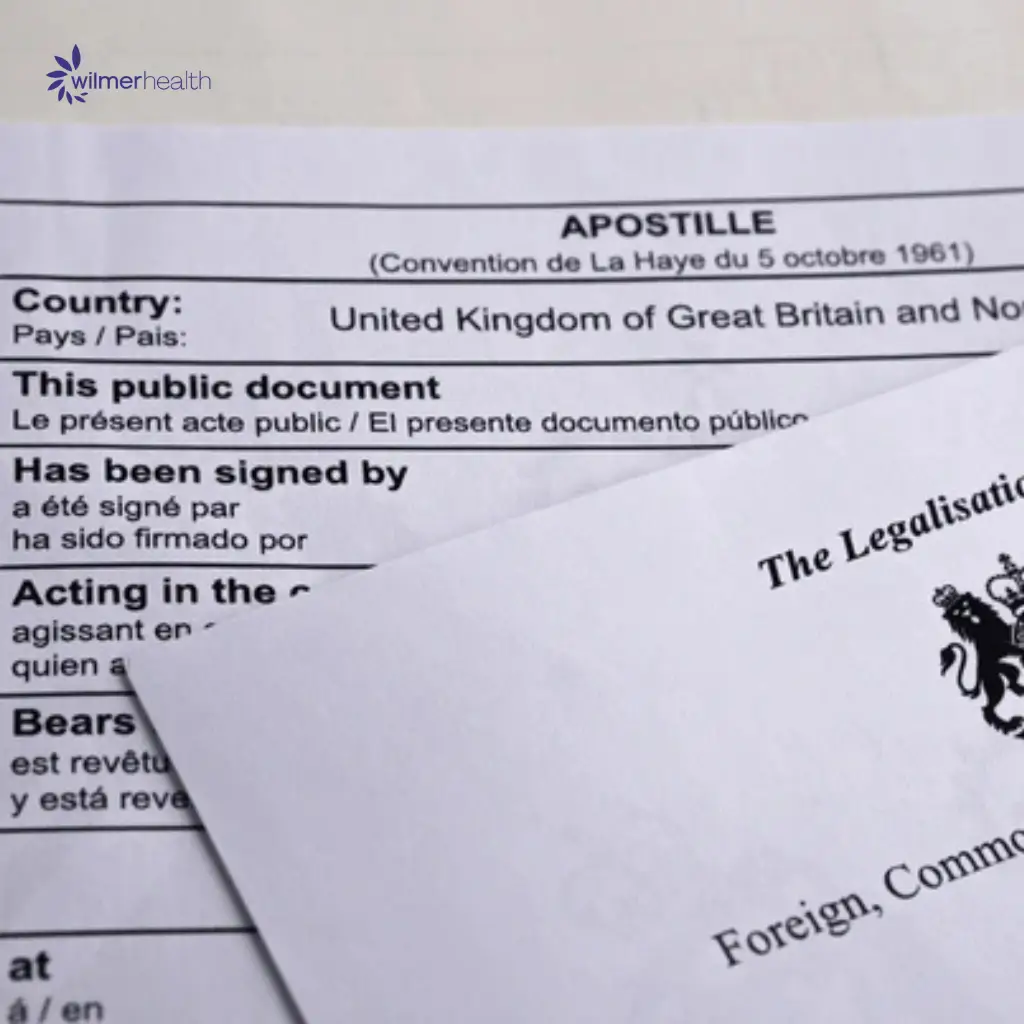
Yes, always — regardless of which application route you use. The apostille is the official FCDO stamp that makes your UK-issued certificate legally recognised in Spain. Without it, your application will not be accepted.
Read our full guide on how to get an apostille for your Spanish visa medical certificate.
Yes, if issued in English. It needs to be a sworn translation — done by a translator officially registered with the Spanish government. A standard translation or one done by a bilingual colleague won’t be accepted.
A bilingual certificate removes this step entirely. At Wilmer Health, our certificates come in both English and Spanish as standard — no separate translation needed, and typically a saving of £75 or more. For someone juggling a full-time remote job alongside a visa application, one less thing to organise is worth a lot.
Read our full guide on getting your Spanish visa medical certificate translated in the UK.
This is the part that’s genuinely specific to DNV applicants, and it’s worth paying attention to.
Route 1 — Applying through the Spanish consulate in the UK: This is the standard route for most UK-based applicants. You apply through BLS International, submit your documents including the medical certificate, and if approved receive a one-year visa stamped in your passport. You then travel to Spain and exchange it for a residence permit.
For this route, the medical certificate timing works the same way as any other long-stay visa — it must have been issued within the 90 days before your consulate appointment. Aim to get it four to six weeks before your BLS appointment to allow time for the apostille and translation.
Route 2 — Applying from within Spain: If you’re already in Spain on a legal tourist stay (UK passport holders get 90 days visa-free in the Schengen Area), you can apply for the DNV directly through the UGE-CE (Large Companies Unit) online portal from within Spain. This route typically results in a three-year residence permit rather than a one-year visa — a significant advantage.
The timing consideration here is different. You need to apply at least 30 days before your tourist stay expires, which can create a tighter window. Your medical certificate still needs to be issued within the 90 days before your application date — but if you’re already in Spain, getting a UK-issued certificate may require some forward planning before you leave.
The practical upshot: if you’re planning to apply via Route 2, get your medical certificate sorted before you travel to Spain. Don’t leave it until you’re already there.
If you’re bringing a spouse, partner, or dependent children as part of your DNV application, each of them will need their own medical certificate — issued separately, apostilled separately, and translated separately.
The DNV is one of the more generous visas in terms of who qualifies as a dependant — spouses, partners, children, and in some cases parents and siblings can all be included. But each one adds to the document workload, so factor in the time and cost of multiple certificates from the outset.
At Wilmer Health, we can handle all family members in the same process so everything arrives together.
Possible in some cases, but not the recommended route. Most NHS GPs don’t offer this service, and those who do are often not FCDO-registered — which means an additional notarisation step before the apostille can be applied. For someone on a tight application timeline, that’s a delay you really don’t want.
Read our full guide on getting a Spanish visa medical certificate through the NHS for the full picture.

At Wilmer Health, we offer a few options depending on your timeline:
No hidden extras, no chasing multiple providers. Read our full guide on how much a Spanish visa medical certificate costs in the UK.
You’ve already done the hard work — researching the DNV, checking your income figures, mapping out the application process. The medical certificate shouldn’t be the thing that slows you down.
At Wilmer Health, everything is online. You fill in a short medical history form, one of our GMC-registered, FCDO-verified doctors reviews it, and your certificate is issued and posted to your UK address — or wherever you need it sent. We issue in bilingual format as standard and can handle the apostille in the same process. If you’re applying as a family, we can manage all the certificates together.
Everything is handled online, and we’re on hand seven days a week if you need us. Got a question before you apply? Drop us a message at hello@wilmerhealth.com — we’re always happy to help.