
 By Dr Andrew Smith | Medical Director, Wilmer Health | Published: 21 April 2026
This guide is reviewed regularly to reflect current Spanish consulate requirements. Last updated in 2026 by Dr Andrew Smith, Medical Director, Wilmer Health. For specific advice about your individual application, contact us at hello@wilmerhealth.com.
If you’re joining a loved one in Spain through the Family Reunification Visa, one of the documents you’ll need is a medical certificate of good health. It’s a simple document, but it has specific requirements that the Spanish consulate needs to see before they will accept your application.
We cover everything below for both UK and US applicants, since the certificate itself is essentially the same, but the legalisation requirements differ slightly between the two countries. For the general process, see our complete guides for UK applicants and US applicants.
 At Wilmer Health, you can get a Spanish visa medical certificate in English and Spanish, signed today by a licensed doctor.
✓ Issued the same day, no appointment needed
✓ Issued on the official bilingual template – saving you sworn translation fees
✓ Hand-signed by a licensed doctor
✓ Original copy shipped to you by priority courier, anywhere in the world
✓ Money-back guarantee if not accepted
✓ Accepted at all Spanish consulates in the UK, USA and worldwide
Or, if you’d like to understand the process in more detail, please read on
Spain’s Family Reunification Visa is designed to help families stay together by allowing non-EU family members to join their loved ones who are already legally living in Spain. The visa is open to:
If you fall into one of these groups, this visa makes it possible for you to move to Spain and live with your family.
When you apply for this visa, the Spanish authorities need to confirm that you don’t have any serious illnesses that could be a risk to public health. The International Health Regulations (2005) outline the diseases covered by this rule.
A medical certificate is the document that confirms this. It shows that you can live in Spain without putting others at risk. Without it, your visa application may be delayed or rejected.

Every family member needs their own medical certificate. This is one of the most commonly overlooked points in Family Reunification applications, especially for families with several members. The certificate is required for:
The sponsor in Spain does not need a medical certificate. They are already legally resident in Spain, so this requirement doesn’t apply to them. It is also worth noting that there is no shared family certificate. For example, if you’re applying with a spouse and two children, that’s four separate certificates.
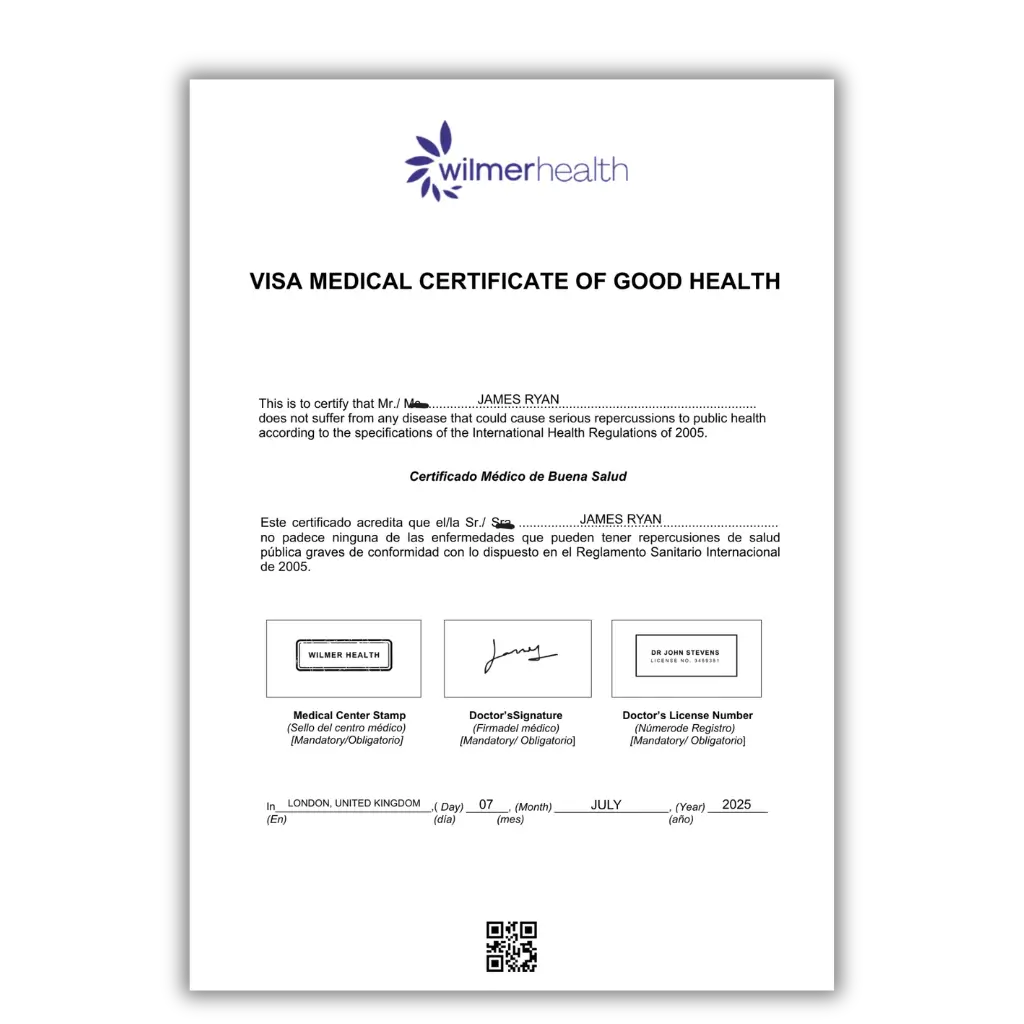
To make sure the Spanish consulate accepts your medical certificate, it needs to meet the following requirements:
Read our full guide on what your Spanish visa medical certificate should say for the exact wording and format requirements.
The medical certificate is valid for three months from the date your doctor signs it. The certificate must still be in date when you submit your application at your Spanish consulate.
The Family Reunification process has a specific sequence that affects timing:
The practical rule: order your medical certificate four to six weeks before your consulate appointment, not earlier.
Getting it too early in the process means it may expire before you submit. The two-month window between Extranjería approval and your consulate application is the right time to arrange it.
If you’re applying as a family with multiple members, time everyone’s certificates together so they’re all in date for the consulate appointment.
This is where the requirements differ between the UK and the USA.
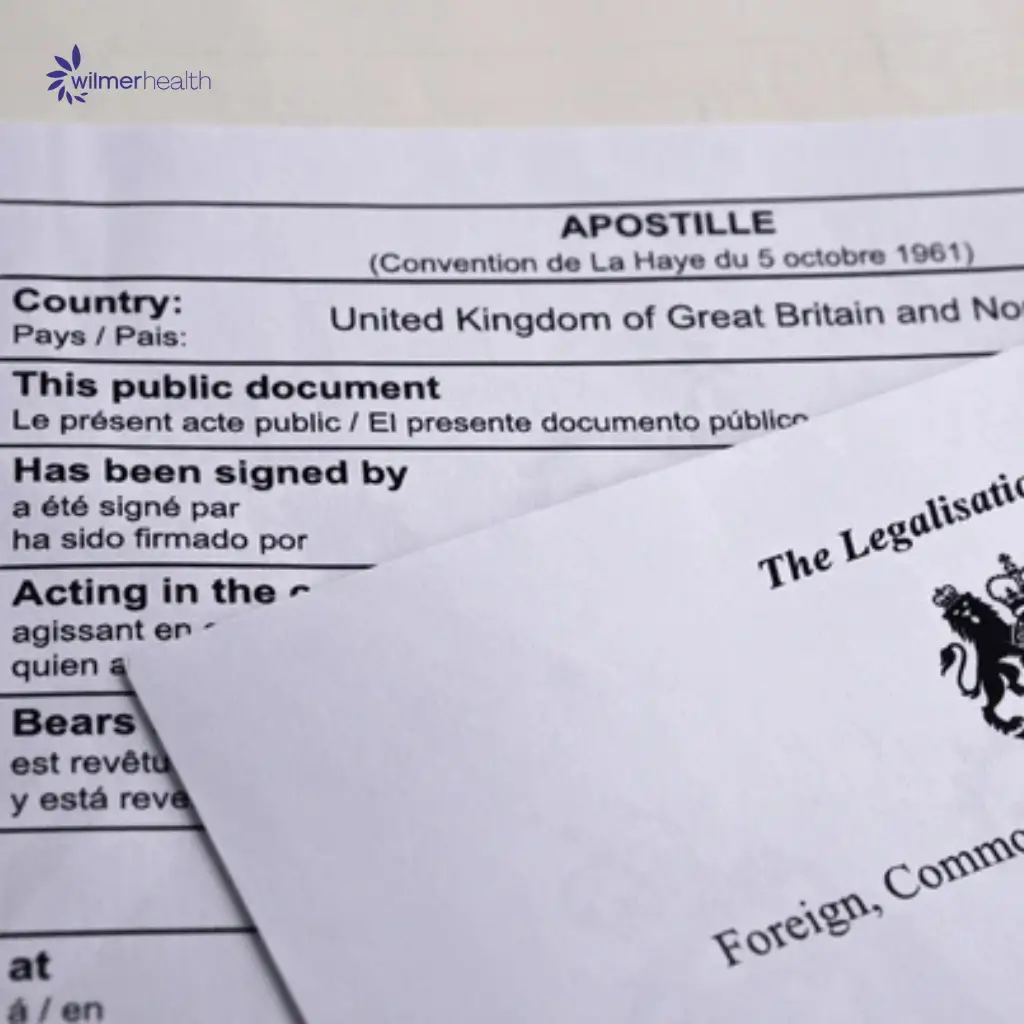
Yes, your medical certificate needs an apostille stamp from the Foreign, Commonwealth and Development Office (FCDO). This is the UK government’s official confirmation that your document is genuine and valid in Spain.
If your certificate is in English only, it must be translated by a sworn translator. The simplest route is to obtain a bilingual certificate (English and Spanish on the same document), which removes the need for separate translation.
No, US applicants don’t need an apostille for the visa medical certificate. Spanish consulates in the USA accept the medical certificate without additional legalisation, provided it meets the standard format requirements (correct wording, doctor’s signature, license number, letterhead, etc).
Translation works the same way: if your certificate is in bilingual English-Spanish format, no separate translation is required. If it’s in English only, you’ll need a sworn translation by a translator registered with the Spanish Ministry of Foreign Affairs.
Apostille requirements vary by country. Most signatories to the Hague Apostille Convention require an apostille; non-signatory countries require consular legalisation.
You have a few options for getting your medical certificate.
A few of the more common mistakes that catch out Family Reunification applicants:
At Wilmer Health, we help families joining loved ones in Spain by providing medical certificates that meet all Spanish consulate requirements. Every certificate is issued by an experienced, licensed doctor in bilingual English-Spanish format, which removes the need for a separate sworn translation.
Each family member completes a short online questionnaire (parents fill in the form on behalf of younger children), and all certificates can be issued together on the same day so they’re all in date for the same consulate appointment.
Every certificate is reviewed and signed by an FCDO-registered doctor, which means we can arrange the apostille for you through direct access to the FCDO counter in Milton Keynes. Bilingual format removes the translation step, and the original certificate is delivered to your UK address by tracked Royal Mail.
Every certificate is same-day issued, hand-signed by a licensed medical doctor (MD), and shipped to your US address by priority courier. The bilingual format removes the need for separate translation, and US applicants don’t need an apostille for the medical certificate.