
 By Dr Andrew Smith | Medical Director, Wilmer Health | Published: 23 April 2025 | Last Update: 27 April 2026
This guide is reviewed regularly to reflect current Spanish consulate requirements. Last updated April 2026 by Dr Andrew Smith, Medical Director, Wilmer Health. For specific advice about your individual application, contact us at hello@wilmerhealth.com.
If you’re applying for a long-stay visa to Spain, France, Greece, South Africa, Thailand, or a number of other countries, your medical certificate will need to be officially stamped — apostilled — before the authorities will accept it. And for that apostille to be applied, the doctor who signed your certificate must be registered with the UK’s Foreign, Commonwealth & Development Office.
This is what people mean when they talk about an “FCDO medical certificate” — a medical certificate issued by a doctor whose credentials are recognised and verifiable by the FCDO. This guide explains what that means, why it matters, and what happens if you get it wrong.
For those applying for a Spanish visa specifically, read our complete guide — Spanish Visa Medical Certificate in the UK: Everything You Need to Know (2026).
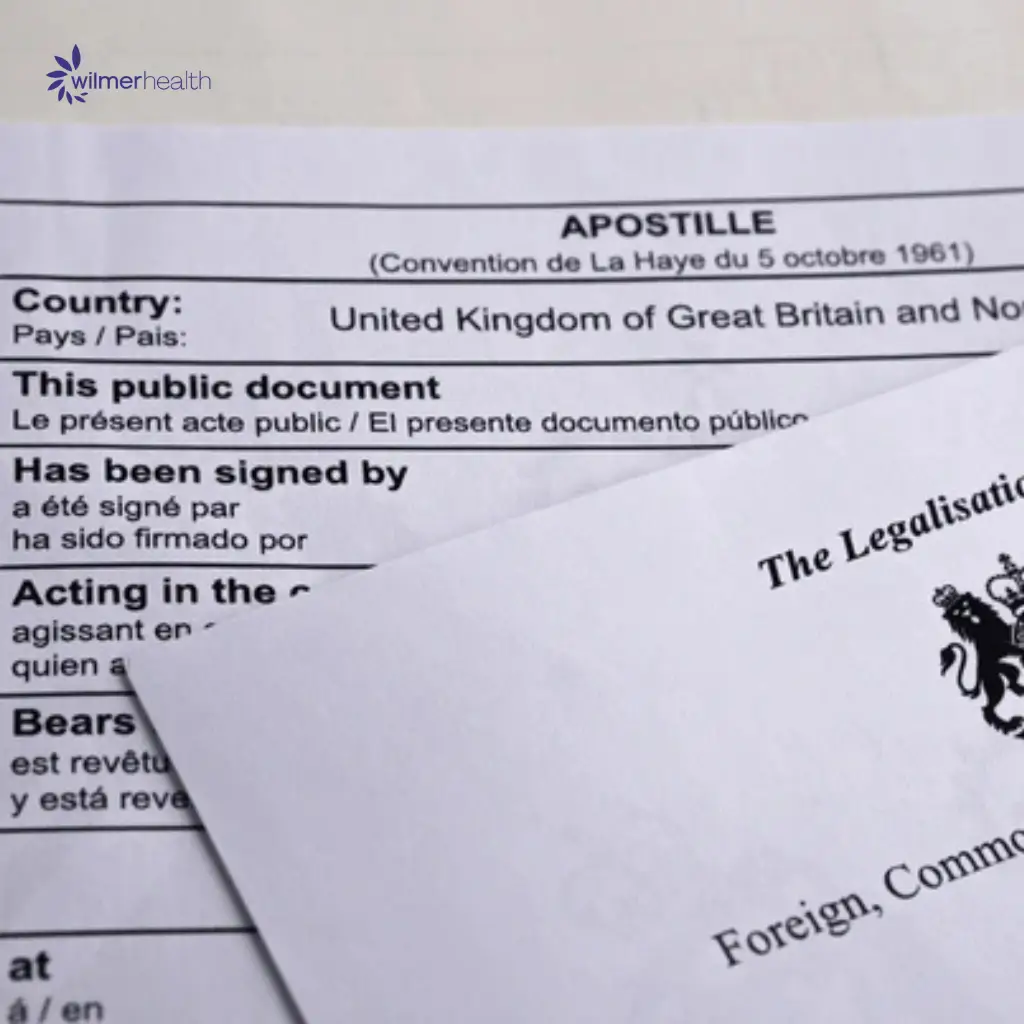
The Foreign, Commonwealth & Development Office (FCDO) is the UK government department responsible for, among other things, legalising UK documents for use abroad. One of the key services it provides is the apostille — an official stamp that confirms a UK document is genuine and has been signed by an authorised professional.
When a foreign government or consulate receives a UK-issued document with an apostille, they can trust that the document is real and that the person who signed it is who they say they are. Without the apostille, most foreign authorities won’t accept UK-issued documents — including medical certificates.
The FCDO maintains a register of recognised signatures — doctors, solicitors, notaries, and other professionals whose signatures they are able to verify. When you submit a medical certificate for apostille, the FCDO checks the signature on the document against their register.
If the doctor’s signature is on the register — meaning they are FCDO-registered — the apostille is applied straightforwardly. If it isn’t, the FCDO cannot verify the document and will refuse to apostille it.
This is what “FCDO-registered doctor” means in practice. It’s not a separate qualification — it simply means the doctor’s signature is known to the FCDO and can be verified when needed.

Any country that is a signatory to the Hague Apostille Convention and requires a medical certificate as part of a visa application will typically need that certificate to be apostilled. For UK applicants, the most common destinations include:
Spain: The most common destination for UK applicants. A medical certificate is required for all Spanish long-stay visas — Non-Lucrative, Student, Digital Nomad, Work, and Family Reunification. The certificate must be apostilled by the FCDO before submission to the Spanish consulate. We cover the full process in our Spanish visa medical certificate service.
France: French long-stay visa applicants often need a medical certificate depending on the visa type. The OFII process in France also involves health checks post-arrival. Our France OFII medical certificate service covers everything you need.
Greece: Greek long-stay D visa applicants require a medical certificate of good health. As with Spain, it must be apostilled for UK applicants — our Greece long-stay visa medical certificate service handles the whole process.
South Africa: Medical certificates are required for certain South African visa categories. UK-issued certificates need apostilling before submission. Our South Africa visa medical certificate service is designed around exactly these requirements.
Thailand: Some Thai visa categories require a medical certificate from a recognised provider. Our Thailand visa medical certificate service covers the specific requirements for Thai applications.
For a full overview of all the countries and visa types we cover, visit our visa medical certificates hub.
This is where a lot of applicants run into problems — often without realising it until it’s too late.
If you get your medical certificate from a doctor who isn’t on the FCDO register, the FCDO will refuse to apostille the document directly. To get around this, you’d need a notary public to first certify the doctor’s signature — effectively vouching for the fact that the signature is genuine. Only then can the FCDO apply the apostille.
This notarisation step adds:
For most applicants who are already working to a tight visa deadline, this is a complication they really don’t need.
The simple way to avoid it is to use a provider whose doctors are already FCDO-registered from the outset. No notarisation needed, no extra steps, no delays.
Most aren’t — and this surprises a lot of people. NHS GPs deal with hundreds of different documents and requests, but visa medical certificates fall outside standard NHS provision. Most GPs haven’t been through the process of getting their signature registered with the FCDO, because it simply doesn’t come up in normal NHS practice.
Some private GPs and clinics are FCDO-registered, but it’s not universal — always check before booking. Read our full guide on getting a Spanish visa medical certificate through the NHS for more detail on why the NHS route is rarely straightforward.
Before committing to any provider, ask them directly: “Are your doctors FCDO-registered?” A reputable specialist provider will be able to confirm this immediately and without hesitation.
If the answer is vague, uncertain, or “we’ll check and get back to you” — that’s a red flag. FCDO registration is a fundamental requirement for apostille, and any provider offering visa medical certificates should know their doctors’ registration status.
You can also check the FCDO’s guidance on document legalisation on the GOV.UK website, which explains the apostille process and what’s required.
At Wilmer Health, all our doctors are GMC-registered and FCDO-verified as standard. We’ve handled thousands of medical certificates for visa applicants across multiple countries, and our FCDO registration has never been an issue.
At Wilmer Health, FCDO registration is built into our service from the ground up. Every certificate we issue is signed by a GMC-registered, FCDO-verified doctor — which means the apostille process is straightforward, with no notarisation step and no unexpected complications.
We issue certificates for a range of visa destinations — for UK applicants heading to Spain, France, Greece, South Africa, Thailand, and more. Our certificates are issued in bilingual format where applicable, and we handle the apostille through direct access to the FCDO counter in Milton Keynes — which means faster turnaround than the standard FCDO route.
Everything is done online. No appointments, no waiting rooms, no chasing multiple providers.
If you’re applying for a Spanish visa, visit our Spanish visa services hub for everything you need in one place. For other destinations, visit our visa medical certificates hub to find the right service for your country.
Got a question before you apply? Drop us a message at hello@wilmerhealth.com — we’re on hand seven days a week.