
 By Dr Andrew Smith | Medical Director, Wilmer Health | Published: 7 May 2025 | Last Update: 22 April 2026
This guide is reviewed regularly to reflect current Spanish consulate requirements. Last updated April 2026 by Dr Andrew Smith, Medical Director, Wilmer Health. For specific advice about your individual application, contact us at hello@wilmerhealth.com.
Your BLS appointment is coming up. You’ve just realised you still need a medical certificate. Or maybe you’ve had one rejected and now you’re starting again with less time than you started with.
Whatever the reason, the good news is this is fixable — even at short notice. The key is knowing exactly what you need, moving quickly, and not wasting time on options that won’t work.
This guide tells you exactly what to do, step by step. If you’re new to the medical certificate process entirely, start with our complete guide — Spanish Visa Medical Certificate in the UK: Everything You Need to Know (2026).
Before you do anything else, count the working days between now and your BLS appointment. This determines which option is right for you.
At Wilmer Health, we offer three turnaround options for our full package — certificate, apostille, and sworn translation all included:
If you have fewer than 4 working days, contact us directly at hello@wilmerhealth.com before placing an order — we’ll tell you honestly what’s possible and what your best options are.
One important thing: count working days, not calendar days. Weekends and bank holidays don’t count. If your appointment is on a Monday, Friday is the last working day before it.
Don’t wait until tomorrow. The certificate is the starting point for everything else — the apostille can’t be applied until the certificate is signed, and the translation comes after that. Every day you delay is a day lost from an already tight timeline.
At Wilmer Health, the whole process is online. You fill in a short medical history form, one of our GMC-registered, FCDO-verified doctors reviews it, and you receive a digital copy of your certificate the same day. The original, wet-ink signed physical copy is posted to your UK address by tracked Royal Mail.
Crucially, our certificates come in bilingual format — English and Spanish on the same document — which removes the need for a separate sworn translation entirely. That’s one less step and typically £75 saved.

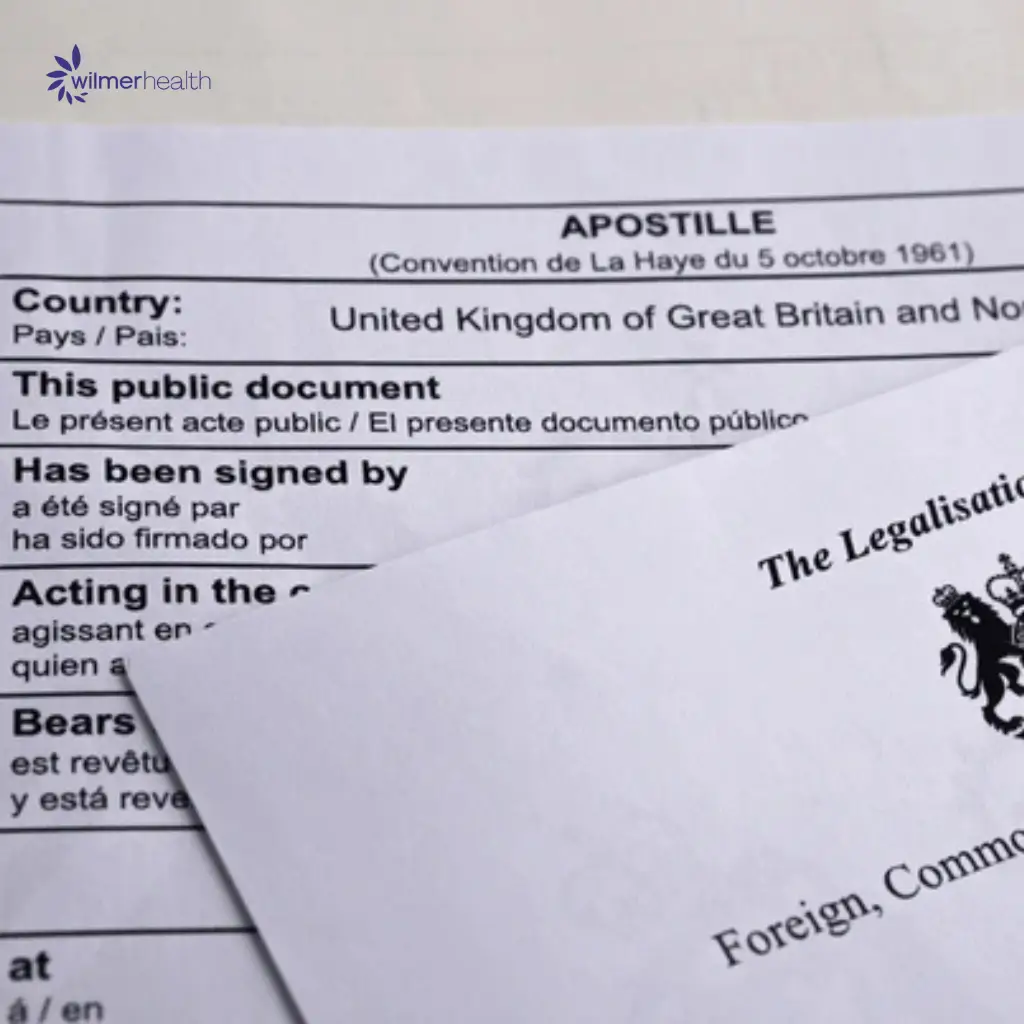
Once your certificate is issued, it needs an apostille before it can be submitted to the Spanish consulate. The apostille is the official FCDO stamp that makes your UK-issued document legally recognised in Spain.
Here’s what most people don’t realise: the standard FCDO route can take much longer than expected, and there’s no guaranteed turnaround time. If you go direct and hit delays, you have very little recourse.
At Wilmer Health, our apostille specialists have direct access to the FCDO counter in Milton Keynes. This is why we can offer guaranteed 4, 5, and 10 working day turnarounds — something the standard FCDO route simply can’t promise.
And because our certificates are bilingual as standard, the translation is already included. You don’t need to find a sworn translator, brief them, wait for the translation to come back, and then send everything off for the apostille. It’s all handled in one process.
If you’re in a rush, a combined package — certificate, apostille, and translation together — is almost always faster and more reliable than trying to coordinate each step separately. Read our full guide on how to get an apostille for your Spanish visa medical certificate and getting your certificate translated in the UK for more detail.
Once everything is ready, make sure you have the following before you head to your BLS appointment:
The original physical certificate — a scan or digital copy will not be accepted. The consulate needs the original with the doctor’s wet ink signature.
The apostille — attached to the original certificate. This confirms the document is genuine and has been issued by a licensed, FCDO-verified doctor.
The Spanish translation — if your certificate is in English only, you’ll need a sworn translation alongside it. If you used Wilmer Health, your certificate is already bilingual so no separate translation is needed.
Check the specific requirements of your BLS centre before your appointment — requirements are consistent across London, Manchester, and Edinburgh, but it’s always worth confirming your full document checklist is complete.
When time is short, it’s tempting to cut corners. Here are the mistakes that most often cause problems:
Trying the NHS GP route. Most NHS GPs don’t offer this service, and those who do are often not FCDO-registered — which means the apostille process becomes more complicated, not less. You’ll lose time, not save it. Read our full guide on getting a Spanish visa medical certificate through the NHS.
Getting the order wrong. Apostille first, then translation. Always. If you translate before apostilling, the sworn translator will need to certify the whole document again — including the apostille. It adds time and cost you don’t have.
Using a provider whose doctor isn’t FCDO-registered. If the doctor isn’t on the FCDO register, the apostille application will hit a notarisation step first. That alone can add days to your timeline.
Assuming digital copies are fine. They’re not. The consulate needs the original physical document with a wet ink signature.
If you need your certificate quickly, here’s exactly what to do:
Choose the package that matches your timeline — 4, 5, or 10 working days. Fill in our short online form. Our doctors review your application and issue your certificate the same day. We handle the apostille through our direct FCDO counter access in Milton Keynes, and everything arrives together, in the right order, ready to submit.
No GP appointments. No chasing multiple providers. No guessing about turnaround times.
If you’re not sure which option is right for your timeline, drop us a message at hello@wilmerhealth.com before you apply — we’re available seven days a week and always happy to help you work out the fastest route.