
 Libbie Stevens | Visa Advisor, Wilmer Health | Published: 10 February 2025 | Updated: 8 May 2026
This guide is for informational purposes only and reflects requirements as understood in 2026. Visa requirements can vary by consulate and are subject to change. Always confirm specific requirements with the Spanish consulate or immigration authority handling your application. For specific advice about your individual application, contact us at hello@wilmerhealth.com.
Studying in Spain is an exciting plan, whether you’re heading to Barcelona for a semester, Madrid for a degree, or somewhere smaller for a language course. The visa process, though, can feel like a lot. There’s plenty of paperwork, the rules changed for UK students after Brexit, and most students we help haven’t done anything like this before.
This guide walks you through everything you need to know: the documents you’ll have to provide, what they cost, where to apply, and how long it all takes. We’ve helped hundreds of UK students through their Spanish visa applications, so we’ll also flag the things that commonly trip people up along the way.
If you just want the headlines, here’s the quick version:
If you’re a UK student going to Spain for more than 90 days, you need a Spanish student visa. You apply at one of the three Spanish consulates in the UK (London, Manchester, or Edinburgh) through the BLS visa application centres.
You’ll need a medical certificate, an ACRO police check (for stays over 6 months), proof you can support yourself financially, health insurance, and proof you’ve been accepted on a course. Most documents need an apostille and a sworn translation into Spanish.
The visa fee is £345 for long-term study (over 180 days), plus £14.85 to BLS. Total cost is usually £700-£2,800 depending on your situation.
Processing takes at least a month, so start at least 2-3 months before your course begins.
 Wilmer Health provides medical certificates, ACRO certificates, sworn translations, apostilles, and Spanish health insurance for UK students. All online, all accepted by the Spanish consulate.
Yes, if your course is longer than 90 days. Since Brexit, UK students no longer have automatic rights to live in Spain. If your course lasts more than three months, you need a student visa before you travel.
If your course is 90 days or less, you don’t need a study visa. UK passport holders can spend up to 90 days in Spain in any 180-day period without a visa, and short courses fall within this allowance.
For anything longer than 90 days, you must apply for the visa from the UK before you travel. You can’t sort it out after you arrive.
UK students applying for a Spanish student visa need:

There are three categories, depending on how long your course lasts:
Up to 90 days, no visa needed. UK nationals can enter Spain visa-free for short courses.
3 to 6 months (91-180 days). The visa fee is £74.65. You don’t need a TIE residency card, and you don’t need an ACRO certificate at this length.
Over 6 months (180+ days). The visa fee is £345. This is the most common visa for UK students at Spanish universities. You’ll need to apply for a TIE card within a month of arriving in Spain, and an ACRO certificate is required.
Most UK students doing degrees, postgraduate courses, or longer language courses will need the long-term visa.
The Spanish consulate publishes its official requirements on the London consulate website. Manchester and Edinburgh ask for the same things. Here’s what you’ll need to gather:
Filled in, signed, and printed. You can download it from the BLS website.
Must have at least one year left, two blank pages, and have been issued within the last 10 years. You’ll need the original plus a photocopy of the photo page.
Colour, white background, taken in the last six months.
An official letter from your Spanish university, language school, or institution. It needs to confirm you’re enrolled full-time, the course dates, and that you’ve paid your registration or tuition fees.
You need to show you have access to at least €600 a month or €7,200 a year. This is 100% of something called IPREM, which is the Spanish government’s official income reference (it’s been frozen at €600/month since 2023). Acceptable evidence:
It’s better to comfortably exceed the minimum than to just meet it. Consulates have rejected applications where the balance was technically high enough but inconsistent or only just above the threshold.
Anything showing your name and address (bank statement, utility bill, tenancy agreement, driving licence, or council tax bill) confirming you live in the right consular district.
Set by the Spanish Ministry of Foreign Affairs. For UK nationals through BLS:
These figures are correct as of 2026. Always check the current fees on the BLS website before you apply.
The four documents that cause the most problems (medical certificate, ACRO certificate, health insurance, and apostille/translation) are covered in detail below.
Every UK student visa applicant needs a medical certificate confirming they don’t have any diseases that could be a public health risk under the International Health Regulations (2005).
For the consulate to accept it, your medical certificate must:
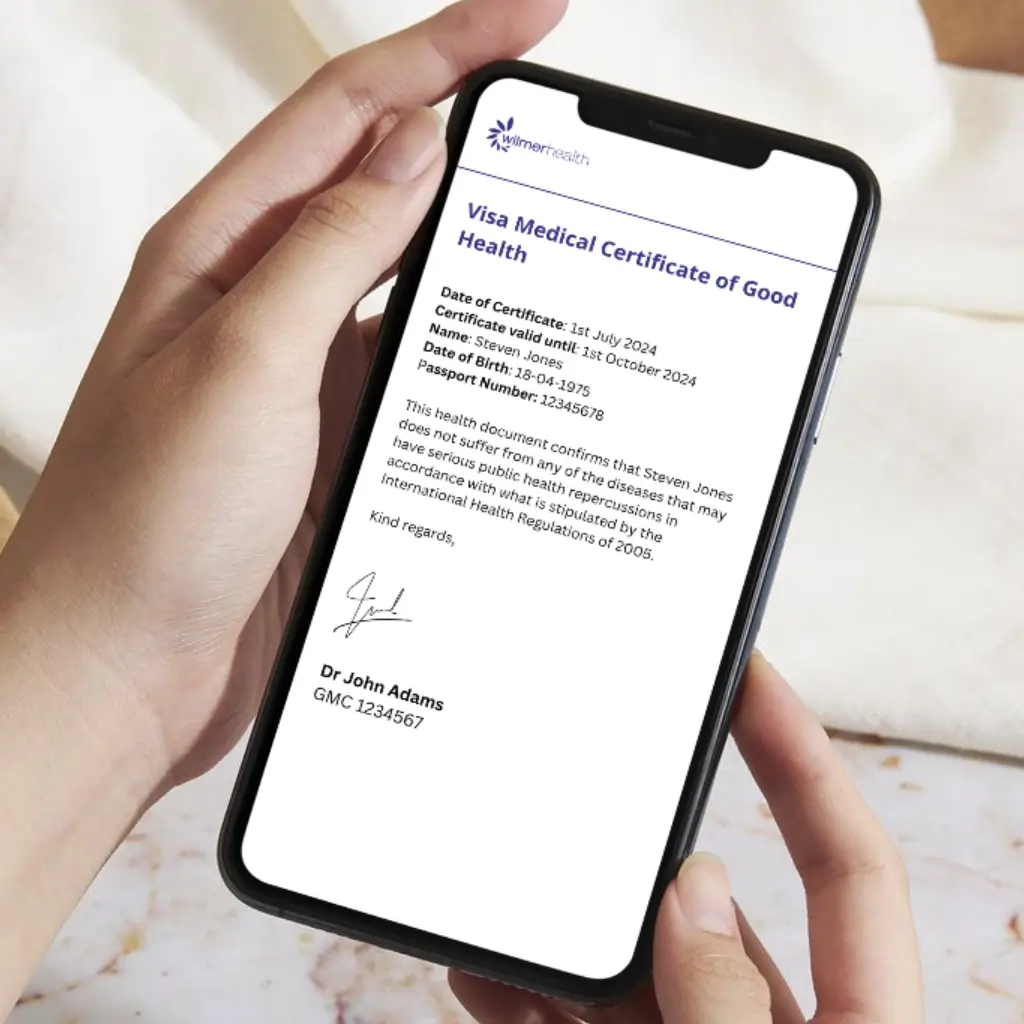
Our Spanish visa medical certificates are issued by GMC-registered doctors with the exact consulate-approved wording. We include the official Spanish translation and can sort the FCDO apostille for you. Same-day online service, no GP visit needed.
If your course is longer than 6 months (180 days), you’ll need an ACRO police certificate covering the past five years. Courses of 6 months or less don’t need one. This is confirmed on the official consulate page.
The ACRO certificate must:
ACRO’s standard service takes up to 10 working days, with a 2-day premium service available for an extra fee. One thing that catches a lot of people out: ACRO sends certificates by standard untracked post. Once it’s in the post, you can’t track it, and Royal Mail can sometimes take a week or more to deliver. We’ve seen certificates take longer to arrive in the post than ACRO took to actually produce them. So when ACRO says “10 working days,” plan for closer to 3 weeks until the certificate is in your hands.
The apostille adds another 2-4 working days through a registered service, or up to 15 working days (often longer in summer) if you go through the FCDO postal route. Apply for your ACRO certificate first. It takes the longest of any document and depends on third parties (ACRO, Royal Mail, the FCDO) you can’t chase or speed up.
If you’re going to Spain as a language assistant in a school, you need an ACRO International Child Protection Certificate rather than the standard one. This is an important difference if you’re going to teach English.

Our ACRO certificate service for Spanish visas handles the whole thing (application, FCDO apostille, sworn translation) and delivers everything to your door.
Related reading: The complete UK guide to ACRO certificates for Spanish visas
The Spanish consulate accepts two types of health cover for student visas. One is much cheaper than the other.
The UK GHIC is accepted by the Spanish consulate as health insurance for all student visas. This is a free card from the NHS, and using it can save you several hundred pounds compared to private insurance.
The GHIC covers any medical care you need during your stay in Spain, on the same terms as Spanish residents (through the Spanish public health system). For most healthy students on a fixed-length course, this is the simplest and cheapest option.
Apply for your GHIC at nhs.uk/using-the-nhs/healthcare-abroad/apply-for-a-free-uk-global-health-insurance-card-ghic. It’s free and usually arrives within about 10 days.
If you’d rather have private cover, your policy needs to meet specific requirements. Standard travel insurance won’t work. The policy must:
Lots of UK travel insurance policies fail on the co-payment or waiting period rules. Be careful with cheap policies marketed as “student travel insurance”. They’re rarely accepted.

Through our partnership with leading Spanish health insurers, we offer policies built specifically for Spanish visa applicants. Zero co-payments, fully accepted by the consulate.
The Spanish consulate requires that some UK documents have an apostille (a legal stamp confirming the document is genuine, under the 1961 Hague Convention) and a sworn translation into Spanish.
The documents that need both an apostille and a sworn translation are:
A regular certified translation isn’t enough. The translator has to be on the Spanish government’s official register of sworn translators.
Important: e-Apostilles are not accepted for Spanish visas. The FCDO offers a cheaper digital apostille (£35 instead of £45), but the Spanish consulate only accepts the paper-based version. Don’t be tempted by the cheaper option. Your visa will be rejected.
The FCDO charges £45 per document for the standard paper apostille. The official turnaround is up to 15 working days, but in reality this is often longer, especially during summer. We’ve seen applications take 3-4 weeks. A registered apostille service typically gets it done in 2-4 working days, because they can submit documents directly at the FCDO business counter rather than queuing through the public postal service.
Sworn translations usually take 2 to 5 working days. Build both apostille and translation time into your timeline.

Our UK apostille service and sworn translation service handles translations for any UK document, and we can arrange the FCDO paper-based apostille on your behalf.
Related reading: The complete guide to apostilles and guide to sworn translations for Spanish visa documents
The visa fee is significant, but document costs add up quickly. Here’s a realistic breakdown for a long-term (over 6 months) student visa:
| Category | Details | Estimated Cost |
|---|---|---|
| Visa fee (long-term study) | Set by Spanish Ministry of Foreign Affairs | £345 |
| BLS service charge | Per visa application | £14.85 |
| ACRO police certificate | ACRO fee (£70 standard, £125 premium) + FCDO apostille (£45) + sworn translation | £165-£250 |
| Medical certificate | Doctor's fee + FCDO apostille (£45) + sworn translation | £150-£300 |
| Birth certificate (if used in sponsorship or under-18) | New certificate + apostille + translation | £110-£220 |
| Parental authorisation (if under 18) | Notarisation + apostille + translation | £120-£250 |
| Health insurance | Free UK GHIC, or private insurance | £0-£600 |
| Travel to consulate appointment | London, Manchester, or Edinburgh | £30-£200 |
| Proof of financial means | €7,200/year minimum (held in your account, not spent) | n/a |
| Estimated total | £700-£2,800 | |
The 3-6 month visa is much cheaper because the visa fee drops to £74.65 and you don’t need an ACRO certificate.
The cost range is wide because document services vary in price, and some people need fast-track options. Bundling services (e.g. a medical certificate that already includes the translation) usually saves £100-£200 compared to arranging each one separately. Using the free UK GHIC instead of private insurance saves £300-£600.
You have to apply at the Spanish consulate covering the area where you live in the UK:
London Consulate: Greater London, the South West, the South East, and Eastern England, plus Guernsey, Jersey, and British Overseas Territories.
Manchester Consulate: Wales, Isle of Man, North West England (except Cumbria), Yorkshire and the Humber, East Midlands, and West Midlands.
Edinburgh Consulate: Scotland, Northern Ireland, and parts of North East England (Cleveland, Cumbria, Durham, Northumberland, Tyne & Wear, Tees Valley including Redcar and Cleveland, Stockton-on-Tees, Hartlepool, Darlington, and Middlesbrough).
You can’t pick your consulate. The one covering your registered UK address is the only one that will accept your application. If you try to apply at a different consulate (because you can get an earlier appointment, say), they’ll reject you straight away.
You apply through the BLS Spain Visa Application Centre for your consulate. Appointments are booked online through the BLS website. During peak season (May-August), London appointments often book up weeks in advance, so book yours as early as you can.
Officially, the consulate has 1 month from the day after you submit your application to make a decision. They can extend this if they ask for extra documents or want an interview. In practice, UK applicants usually wait 4-8 weeks during normal periods, longer in peak summer months.
The Spanish consulate’s own guidance says you should apply at least two months before your course starts.
A few things that affect how long it takes:
Suggested timeline for a September course start:
The biggest mistake UK students make is leaving the ACRO certificate until last. It involves three separate steps (ACRO, the FCDO apostille, and the sworn translation), each with their own waiting times. Once you’re behind schedule, there’s no way to speed any of them up.
Yes, up to 30 hours a week, as long as your work doesn’t get in the way of your studies.
In practice, most UK students working in Spain end up in hospitality, English tutoring, or paid internships organised through their university or course provider.
Your visa has fixed dates. Spanish border control may turn you away if you arrive before the start date.
You have three options:
Wait until the visa starts. Safest. Travel on or after the start date on your visa.
Go as a tourist first. As a UK passport holder, you can stay in Spain visa-free for up to 90 days under Schengen rules. You’d then need to leave Spain and come back once your student visa starts.
Ask for an earlier start date. When you submit your application, ask the consulate if your visa can start earlier. London, Manchester, and Edinburgh handle these requests differently, so check before you apply.
If you’re planning to arrive early, ask your consulate beforehand whether you’ll need to leave Spain and re-enter to activate the visa.
If your visa is for more than 6 months, you must apply for a Tarjeta de Identidad de Extranjero (TIE), your Foreigner Identity Card, within a month of arriving in Spain.
The TIE includes your NIE (Número de Identidad de Extranjero), the Spanish foreigner ID number you’ll need for everything from opening a bank account to signing a rental agreement.
To get your TIE:
Once the TIE is issued, your original visa stops being valid. The TIE becomes your residency document. If your visa is 6 months or less, you don’t need a TIE – the visa itself covers your whole stay.
From our experience helping UK students with their visa documents, these are the most common reasons applications fail:
Medical certificate problems: wrong wording (not matching the consulate’s exact phrasing about IHR 2005), certificate from a country other than the UK or Spain, missing apostille, or doctor’s signature not recognised by the FCDO.
Translation problems: using a regular certified translation instead of a sworn one, or using a translator who isn’t on the Spanish government’s official register.
Not enough money shown: bank balance dipping below €600/month at any point during the 6-month review window, or sponsorship letters submitted without all the required supporting documents (parents’ employer letter, bank statements, apostilled birth certificate).
Health insurance not accepted: policies with co-payments, reimbursement models, or not enough cover. Travel insurance is never accepted, even with €30,000 cover.
Wrong apostille type: submitting an e-Apostille (£35 digital) instead of the paper-based apostille (£45). Spanish consulates only accept the paper version.
Wrong consulate: applying outside your consular district.
Out-of-date documents: medical certificates over 3 months old, or ACRO certificates over 6 months old at your appointment.
Most rejections aren’t because the applicant doesn’t qualify. They’re because of small administrative slip-ups. Frustrating, time-consuming, and almost always avoidable with the right preparation.
A Spanish student visa isn’t difficult, but it is bureaucratic. It rewards preparation. Start at least three months before your course begins, apply for your ACRO first, and double-check every document meets the consulate’s exact requirements.
At Wilmer Health, we help UK students get every document right the first time. Our Spanish visa services for students include:
Everything’s done online and delivered to your door. Get started now to make sure your documents are ready in time for your academic start date.

For UK retirees and early retirees moving to Spain
A deeper look at health insurance options if the GHIC isn’t suitable
All key facts in this article were checked against official sources as of May 2026: